


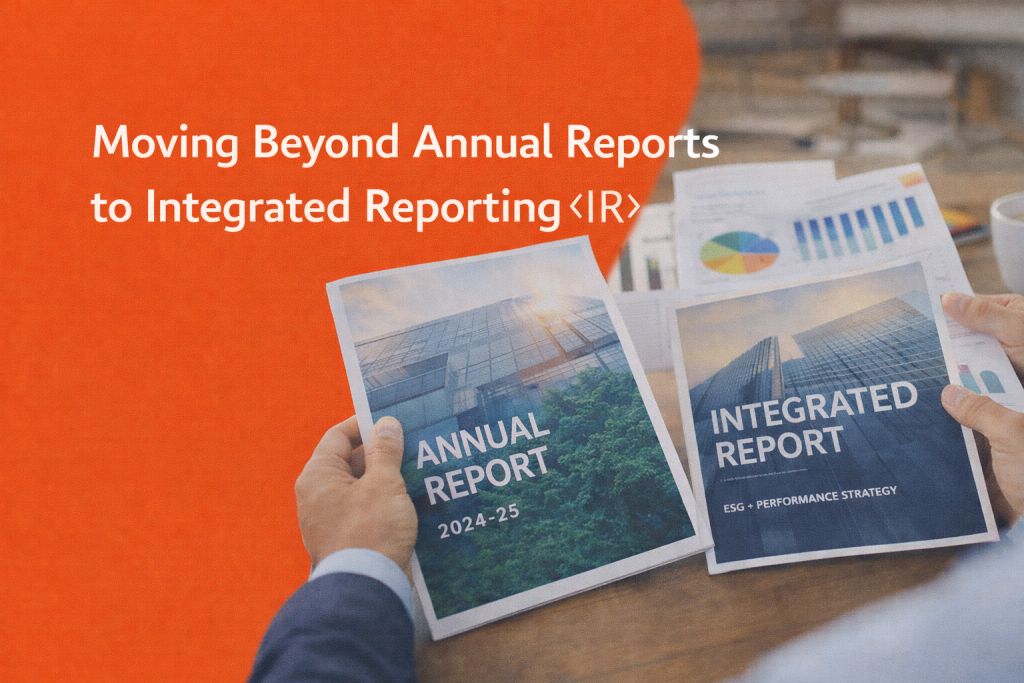
Moving Beyond Annual Reports to Integrated Reporting <IR>
Traditional annual reports focus on last year’s financials and often leave readers with an incomplete picture of value creation. In fact, experts note that annual reports “fail to capture critical information about the company’s long-term value,” offering siloed, backward-looking data. They typically highlight revenue, assets and basic CSR snippets, but do little to address sustainability risks or future strategy. In today’s world, stakeholders demand more – combining fiscal performance with environmental, social and governance (ESG) context.
Evolving Investor and Stakeholder Expectations
Investors now expect both financial and non-financial information, along with forward-looking disclosures. Surveys find that 66% of business leaders agree that “financial reporting alone fails to reflect the full performance and value” of their organization. Seven in ten say integrating ESG and financial data leads to better strategic decisions. Globally, initiatives like the UN Principles for Responsible Investment (PRI) – with over 5,200 signatories managing $139.6 trillion – highlight this shift. In practice, ESG-focused funds have seen explosive growth (reaching about $3.56 trillion AUM by end-2024) and are projected to hit nearly $34 trillion by 2026. Institutional investors are demanding sustainability data and future-oriented planning, not just past-year profit figures.
What Integrated Reporting Offers
Integrated Reporting <IR> provides the holistic, strategic view that modern stakeholders need. By linking financial results with environmental, human and social “capitals,” <IR> reveals how value is created, preserved or eroded over the short, medium and long term. According to the IFRS Foundation, <IR> should “draw on different reporting strands and communicate the full range of factors that affect the ability of an organization to create value over time”. In practice, integrated reports elevate ESG information alongside finance. For example, an analysis from a global consulting firm, found that combining non-financial metrics gives a more complete view of performance and enables faster, more confident decision-making. Industry commentators agree that <IR> “has the potential to clearly show how companies are creating long-term value” by weaving sustainability into strategy.
Global ESG Momentum and India’s Initiatives
This shift is backed by both global and Indian trends. Beyond PRI and fund flows, major regulators now require ESG disclosure. In India, SEBI has mandated the new Business Responsibility and Sustainability Report (BRSR) for the top 1,000 listed firms (voluntary in FY 2021–22, compulsory from FY 2022–23). Market indicators also favour ESG; studies show India’s NIFTY ESG index consistently outperforms the traditional index, delivering higher returns and better risk-adjusted performance through market cycles. Such evidence – including a recent finding that the NIFTY ESG posted ~59% cumulative return vs ~44% for the NIFTY100 (2020–21) – reinforces that sustainable practices pay off.
Organizations embracing <IR> multiple advantages. It builds stakeholder trust, since transparent ESG disclosure and cohesive strategy communicate authenticity. It improves decision-making by breaking down silos and linking risks and opportunities across the business. Employees, investors and customers appreciate purpose-driven communication – Deloitte notes that workplaces emphasizing people (diversity, inclusion, wellbeing) “create value that can enable superior performance”. Strong ESG integration also boosts financial results; firms with robust sustainability practices often cut costs, mitigate risks and attract better capital, yielding higher margins. Finally, an integrated report streamlines ESG communication: instead of separate CSR newsletters, companies can efficiently present all metrics in one narrative, reducing stakeholder confusion.
- Benefits at a glance: Enhanced stakeholder trust and credibility; better strategic and operational decisions; stronger employee engagement and talent attraction; improved profitability through cost savings and innovation; and clear, efficient ESG reporting to investors.
Take the Next Step The evidence is clear: businesses are evolving toward stakeholder-centric reporting. To stay competitive and credible, listed companies should begin transforming their reporting approach now. Moving to an Integrated Report aligns strategy with ESG commitments, drives long-term value, and meets investor and regulatory expectations. Forward-thinking organizations can seek expert partners – auditors, consultants or <IR> specialists – to guide this journey. In doing so, they not only future-proof compliance, but gain the strategic insights and trust that come with Integrated Reporting.
Recent Post
Why ESG-Led Integrated Reporting <ir> Is Redefining Corporate Reporting</ir>
Interactive Annual Reports: Examples That Stand Out

The Role of Design in Turning Financial Data into Powerful Business Stories

Beyond the Balance Sheet: Why Integrated Annual Reports are Reshaping Corporate Communication