


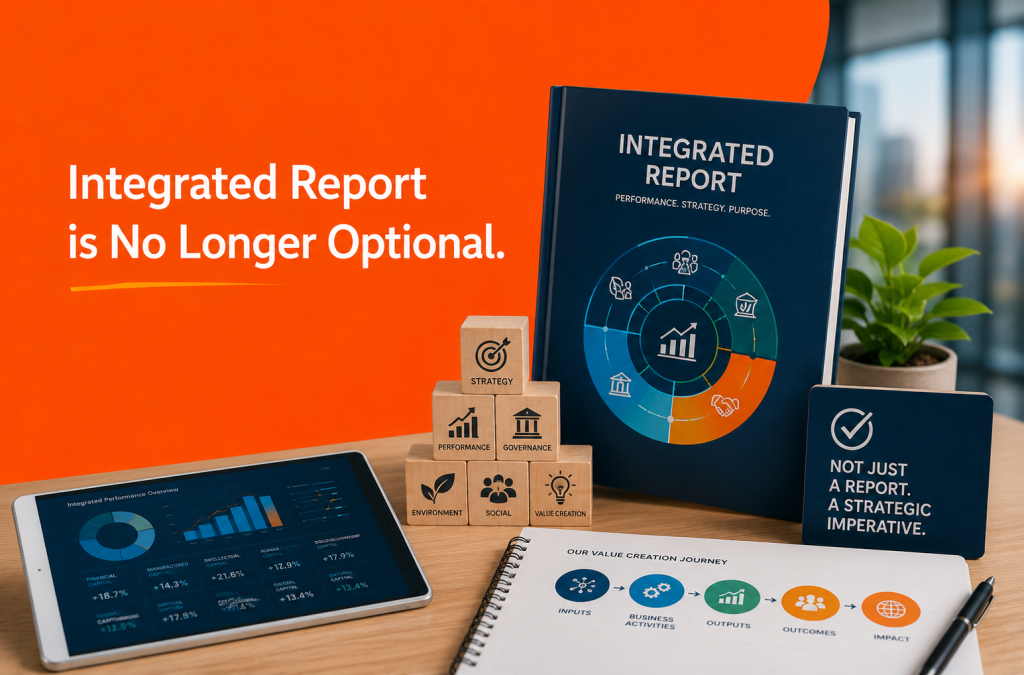
Integrated Report is No Longer Optional
What recent ESG regulatory developments mean for how companies must communicate value to investors and stakeholders in 2026 and beyond.
There is a moment in every significant regulatory shift when companies that moved early look prescient, and those that waited look unprepared. For ESG disclosure, that moment has already passed.
Between 2023 and 2025, the architecture of corporate sustainability reporting changed in ways that are structural rather than cyclical. The European Union’s Corporate Sustainability Reporting Directive (CSRD) came into force, pulling roughly 50,000 companies into mandatory double materiality assessments. India’s SEBI made the Business Responsibility and Sustainability Report (BRSR) mandatory for the top 1,000 listed companies and introduced BRSR Core with third-party assurance requirements. The International Sustainability Standards Board (ISSB) released IFRS S1 and S2, and jurisdictions from the UK to Singapore began aligning national disclosure frameworks accordingly. In the United States, the SEC established enforceable requirements for Scope 1 and Scope 2 emissions reporting for public companies.
None of this is voluntary anymore. And that is precisely why the integrated report matters more now than at any point in the last decade.
What Integrated Reporting Actually Means
The integrated report is not another name for an annual report with an ESG chapter appended to it. It is a document structured around a fundamentally different question: not what did the company do financially, but how does the company create value over time, for which stakeholders, using which capitals, and at what risk to each of them.
The International Integrated Reporting Framework, now maintained under the IFRS Foundation, describes six capitals: financial, manufactured, intellectual, human, social and relationship, and natural. An integrated report explains how management deploys and protects each of these over short, medium, and longtime horizons. Critically, it makes the connections between them explicit, showing how an investment in human capital produces intellectual capital that feeds financial performance, or how natural capital degradation creates material financial risk.
This is not a design exercise. It is a disclosure exercise with design consequences. The report structure must follow the logic of value creation, which means financial statements and sustainability disclosures cannot be treated as separate documents belonging to different parts of the business.
Why the Current ESG Regulatory Moment Makes This Urgent
The escalation of mandatory ESG frameworks has created a specific and practical problem for companies that continue to produce separate financial and sustainability reports. Double materiality under CSRD requires companies to assess not only how ESG factors affect their own financial performance, but how their operations impact the environment and society. ISSB standards require sustainability-related financial risks and opportunities to be disclosed alongside financial statements, not independently of them.
A company that reports strong Scope 1 and Scope 2 emissions reductions in one document and capital expenditure plans in another is asking its readers to make the connection themselves. Institutional investors, who increasingly use ESG data as an input to financial models rather than a separate ethical screen, will notice that gap. Most will not fill it themselves.
The integrated report solves this structurally. Connectivity is built into the document architecture, not left to the reader’s inference.
What Institutional Investors Now Expect from ESG Disclosure
The shift in investor behaviour over the past three years has been measurable. ESG-linked assets under management continue to grow, even as the definition of qualifying ESG investment has tightened under regulatory scrutiny. What has emerged is a more demanding institutional investor, one less interested in sustainability commitments and considerably more interested in sustainability performance, and specifically in how that performance connects to financial outcomes.
Proxy advisors and index providers have made this explicit. ISS ESG, Sustainalytics, S&P Global’s Corporate Sustainability Assessment, and MSCI all weight disclosure quality significantly in their scoring methodologies. A well-structured integrated report that demonstrates connectivity between capital allocation decisions and ESG outcomes scores materially higher than a compliance-formatted sustainability report containing the same underlying data. The difference is not in the data itself. It is in the architecture of how it is presented and connected.
For companies with significant institutional ownership, this architecture is not a communication preference. It is a valuation input.
The Practical Case for Companies Not Yet There
Many organisations delay integrated reporting because it requires coordination between investor relations, sustainability, finance, and communications teams that have historically operated as separate functions. The annual report is owned by investor relations. The sustainability report is owned by the ESG or corporate affairs team. Bringing these into a single, coherent, connectivity-demonstrating document requires both a governance decision and an editorial one.
The governance decision is: who owns the integrated report, and how are material topics agreed across functions? Companies that have made this transition successfully typically establish a cross-functional report steering group, with the CFO and Head of Sustainability jointly accountable for the final disclosure.
The editorial decision is: what is the narrative logic that connects financial performance to capital management to stakeholder outcomes? This is where design and editorial rigour intersect. The document must be structured so that a reader can move from the company’s stated strategy, through its material risks and opportunities, to operational performance, to financial outcomes, without losing the thread. That is a significantly harder editorial problem than producing a well-designed annual report and a well-designed sustainability report as separate exercises.
Companies that have solved it are producing disclosures that are more useful to institutional readers, more defensible under regulatory scrutiny, and more coherent as representations of how the business actually functions.
The Cost of Keeping Financial and Sustainability Reporting Separate
The gap between companies with integrated disclosures and those with siloed reports is widening. Companies on the integrated side are increasingly associated with higher ESG ratings, stronger investor relations outcomes, and greater institutional confidence. Those on the siloed side are increasingly flagged for disclosure gaps by proxy advisors and excluded from ESG-linked indices.
This gap will deepen as CSRD phasing continues to expand its scope, as BRSR Core assurance requirements mature, and as ISSB standards gain mandatory adoption across more jurisdictions through 2026 and 2027. Companies that build the editorial, governance, and design infrastructure for integrated reporting now will be ready for the next phase of requirements. Those that wait will build the same infrastructure under greater regulatory pressure, with less time, and with more exposure.
The Integrated Report as a Strategic Investor Communication Asset
An integrated report prepared to this standard is not a compliance document. It is the clearest possible statement of how a company understands its own business: what creates value, what erodes it, who bears the risk, and what management is doing about it. That kind of document earns institutional attention in a way that separate financial and sustainability reports, however professionally designed, cannot replicate.
The ESG landscape has changed. The regulatory frameworks are in place. The institutional expectations are established. The question for boards and management teams is not whether integrated reporting is relevant to their organisation. It is whether the organisation is ready to do it properly.
Recent Post
From Spend to Story: Making India's CSR Reports Work Harder
CSR Report: Communicating Impact through Purpose-driven Reporting and Effective Design
Annual Report Design Services: Transforming Corporate Performance into Powerful Brand Stories
ESG Design Services: Crafting Powerful ESG Reports that Inspire Trust, Transparency & Sustainable Growth