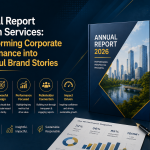




Beyond Compliance: The Annual Report as a Strategic Investor Communication Asset
An annual report occupies a singular position in a company’s communications calendar. It is the one document that institutional investors, analysts, and board members typically read end to end, and the one that holds management to account across twelve months of stated intentions and actual outcomes. The quality of its construction influences how credible a company appears, before a single financial figure is examined.
A well-constructed annual report does more than present numbers. It communicates a company’s strategic journey, validates the credibility of its stated ambitions, and gives stakeholders a coherent basis on which to form a considered view.
Why Annual Report Design Matters More Than Ever
Institutional investors review dozens of annual reports in any given cycle. The ones they annotate, reference in briefings, and return to share a common quality: financial data is legible at a glance, the strategic narrative holds from beginning to end, and the design serves the content rather than competing with it. A report built with this discipline –
- Builds investor confidence
- Enhances corporate credibility
- Reinforces brand identity and market positioning
- Simplifies complex financial data
- Improves stakeholder engagement
- Strengthens ESG and sustainability communication
- Improves navigability across print and digital formats
Companies that treat the annual report as a design and editorial challenge in equal measure gain a measurable advantage in how stakeholders process and retain the information it contains.
The Shift from Traditional Reports to Storytelling Experiences
The format has shifted materially. A report that functions as an investor communication tool today integrates:
- Interactive digital experiences
- Infographics and data visualization
- Integrated ESG narrative grounded in measurable targets
- Leadership perspective with strategic specificity
- Brand-focused layouts
- Mobile-friendly PDF designs
- Minimalist and modern aesthetics
The measure of success is a document that rewards sustained reading and holds up under reference.
The most effective reports integrate content strategy, financial presentation, and design discipline from the outset, rather than treating design as a finishing layer applied to a completed text.
Key Elements of a High-Impact Annual Report Design
1. Strong Visual Identity
Visual consistency in an annual report communicates institutional rigour to readers who encounter dozens of documents annually. Typography, colour, and layout choices signal whether the information was prepared with care and that signal is processed before the text is read.
Every page should serve the reader’s comprehension. Design choices that prioritise aesthetic over clarity work against the document’s primary purpose.
2. Engaging Data Visualization
Complex numbers become legible through well-chosen charts, annotated timelines, KPI dashboards, and structured financial highlights — each selected for the insight it surfaces, not for visual variety. The editorial discipline is in deciding what not to show. Visual excess produces the same cognitive load as dense text.
3. ESG and Sustainability Reporting
ESG disclosures have moved from the periphery of the annual report to its centre. Institutional investors, proxy advisors, and index providers now treat the quality and specificity of ESG reporting as a proxy for management quality itself and not as a separate compliance category.
Modern annual reports now include:
- Carbon reduction initiatives
- Diversity metrics
- CSR achievements
- Governance frameworks
- Sustainability roadmaps
Structured ESG presentation — with clearly stated targets, progress metrics, and third-party assurance — carries considerably more weight with institutional audiences than graphically elaborate but substance-light sustainability sections.
4. Digital-First Design Approach
Annual reports are increasingly accessed on screens, referenced mid-conversation, and forwarded in fragments. A digital-first design approach does not lower editorial standards; it applies them to a different consumption context.
Today’s reports often include:
- Interactive navigation
- Clickable indexes
- Embedded videos
- Mobile-responsive layouts
- Web-based report formats
Format parity matters: a report designed for digital consumption should maintain the same editorial standards as its print counterpart. Navigability accelerates comprehension; it does not substitute for it.
Trending Annual Report Design Styles in 2026
Minimalist Corporate Design
Clean layouts, bold whitespace, and elegant typography dominate modern corporate reports. Minimalism improves readability while creating a premium appearance.
AI-Assisted Data Visualization
Analytical tools now allow teams to surface inflection points, period-on-period comparisons, and segment breakdowns that static presentations often obscure. The editorial discipline lies in selecting which insights merit prominence and presenting them without burying the context that makes them meaningful.
Sustainability-Focused Themes
Green visuals, eco-inspired graphics, and ESG-centric storytelling continue to trend strongly among global brands.
Interactive PDF Reports
Interactive reports with clickable sections and animated elements are becoming standard for digital stakeholder engagement.
Human-Centric Storytelling
Operational narrative — employee capability, customer outcomes, research and development cadence — provides the evidence base that validates financial performance claims. Investors reading for investment conviction, not just compliance, look for this material.
Why Bespoke Design Outperforms Template-Based Approaches
Template reports signal operational economy, not strategic intent. Every company with something substantive to communicate needs a document architecture that reflects the specifics of its story, its capital structure, and its stakeholder relationships.
Experienced custom annual report designers offer:
- Tailored visual strategies
- Industry-specific design expertise
- Investor-centric layouts
- Editorial discipline in narrative structure
- Brand consistency
- Readability without condescension
- Design execution that serves content over aesthetics
The most effective annual report engagements combine financial subject matter expertise, editorial discipline, and design sensibility within a single integrated process and not as sequential handoffs between separate functions.
Tailoring the Approach by Audience and Industry
The editorial and design challenges differ significantly by sector. The relevant considerations include:
- Listed companies answering to institutional equity investors and index providers, where financial narrative, ESG specificity, and forward guidance carry distinct weighting
- Financial institutions where regulatory capital reporting, stress test disclosures, and ESG commitments require careful sequencing and specialist treatment
- Healthcare and pharmaceutical companies where clinical pipeline, regulatory progress, and scientific narrative carry equal weight to financial reporting
- Technology firms where product roadmap, talent density, and intellectual property often constitute the primary investment thesis alongside the P&L
- Industrial and manufacturing companies where supply chain resilience, energy transition progress, and capital expenditure discipline are the metrics that matter most to investors
In each case, the report structure should reflect what drives the company’s valuation and what its most important audiences actually need to know — not what satisfies a generic annual report format.
The Investor Relations Value of Digital Annual Reports
A digital-first annual report extends the document’s utility well beyond the AGM cycle. An indexed, navigable online report:
- Allows institutional investors to reference specific sections in analysis and briefings
- Supports analyst desk research without reliance on third-party summaries
- Ensures the company’s stated positions are what surface in due diligence searches
- Strengthens the investor relations cycle between reporting periods
- Generate media interest
- Supports employer branding with prospective senior hires conducting independent research
What Good Annual Report Partnership Looks Like
The agency or design team responsible for an annual report should be able to read a balance sheet, interrogate a strategic narrative, and ask whether the stated numbers support the stated story before a single page is designed.
A capable annual report team brings:
- Substantive engagement with financial content, not just the presentation of it
- Corporate narrative development grounded in the actual numbers
- Financial report layouts
- ESG report design
- Infographic development
- Print and digital report formats
- Design that reinforces strategic positioning without overpowering the content
The measure of a well-designed annual report is not its visual complexity. It is whether an investor who reads it comes away with a clearer, more confident view of the company.
An annual report is the most consequential communication a public company produces in any given year. The quality of its execution — editorial and visual in equal measure reflects on the quality of the management that produced it.
Companies that approach the annual report with the same rigour they apply to investor presentations, earnings calls, and regulatory filings produce documents that generate institutional confidence — not just compliance.
A report built to that standard does not require a call to action. It makes its own case.
Recent Post

The trends redefining corporate disclosure – what large corporates need in a partner

From Compliance to Competitive Advantage: How Strategic CSR Reporting Drives Business Value

From Spend to Story: Making India's CSR Reports Work Harder
CSR Report: Communicating Impact through Purpose-driven Reporting and Effective Design