



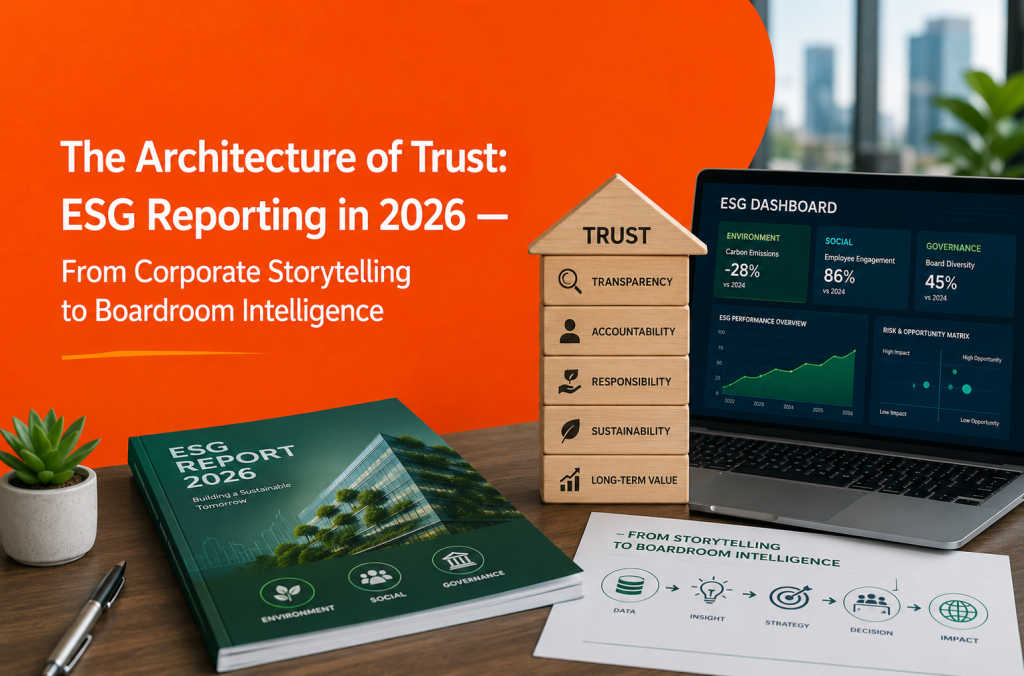
The Architecture of Trust: ESG Reporting in 2026 — From Corporate Storytelling to Boardroom Intelligence
There was a time when ESG reporting lived quietly at the back of annual reports—polished PDFs filled with corporate ambition, carbon charts, and carefully chosen narratives. Today, that era is definitively over. In 2026, Environmental, Social, and Governance (ESG) reporting has matured into one of the most strategic, scrutinized, and technologically transformed functions inside modern enterprises.
Sustainability disclosures are no longer marketing assets or branding exercises. They have evolved into audit-ready business intelligence systems that directly influence investor confidence, regulatory compliance, supply chain resilience, and ultimately, enterprise valuation.
What Changed? The Convergence of Three Macro Forces
The rapid transition from passive disclosures to active operational governance didn’t happen in a vacuum. A complete reinvention of corporate sustainability reporting was triggered when three macro forces collided simultaneously:
- The Rise of Mandatory Disclosure Regimes: Regulations such as the European Union’s Corporate Sustainability Reporting Directive (CSRD) have codified sustainability into law, shifting ESG from voluntary transparency to regulated accountability.
- Investor Demand for Verifiable Data: Capital allocators have discarded boilerplate narratives in favor of measurable, comparable, and numerically rigorous sustainability data to adequately price long-term portfolio risk.
- The Explosive Integration of Artificial Intelligence: The scaling of advanced AI architectures has radically redefined data ingestion, analytics, and assurance workflows, turning back-office compliance into an active boardroom intelligence asset.
Organizations that continue to treat ESG as a creative branding exercise are rapidly discovering that they are operating several years behind the market, exposed to severe legal, financial, and reputational risk.
The Global Blueprint: Navigating Essential ESG Frameworks
To achieve compliance and communicate clearly in this mature market, organizations must baseline their reporting against globally recognized architectural standards. These core frameworks provide the keywords, taxonomies, and structures that professional market participants demand:
1. Corporate Sustainability Reporting Directive (CSRD) & ESRS
The EU’s CSRD, backed by the European Sustainability Reporting Standards (ESRS), is currently the world’s most aggressive regulatory framework. It mandates cross-border compliance, requiring detailed disclosures on operational impacts and mandatory independent third-party assurance. It legally institutionalizes the concept of double materiality, forcing firms to provide structural transparency across their entire upstream and downstream value chain.
2. IFRS Sustainability Disclosure Standards (ISSB: S1 & S2)
Issued by the International Sustainability Standards Board, IFRS S1 (General Requirements) and IFRS S2 (Climate-related Disclosures) create a universal financial baseline that has been rapidly adopted across multiple global jurisdictions. Fully absorbing the legacy TCFD framework, the ISSB standards compel entities to articulate exactly how sustainability-related risks and opportunities materially impact their financial position, cash flows, and access to capital over short, medium, and long-term horizons.
3. Global Reporting Initiative (GRI)
While the IFRS looks through a lens of financial materiality, the GRI remains the global gold standard for impact materiality. It provides organizations with a structured methodology to report public disclosures regarding their multi-faceted impact on the economy, the environment, and human rights, servicing a broad spectrum of multi-stakeholder accountability rather than just capital providers.
4. CDP (Formerly Carbon Disclosure Project)
Operating the world’s primary environmental disclosure system, CDP utilizes targeted, sector-specific questionnaires to evaluate corporate environmental transparency. Achieving a high CDP score acts as a vital performance indicator for institutional investors, signalling rigorous operational tracking of greenhouse gas emissions, water security, and deforestation exposure.
Double Materiality: The Concept Reshaping Corporate Reporting
At the heart of modern framework implementation lies Double Materiality. Traditional financial reporting operates under a single dimension—how external environmental factors financially influence the company’s ledger. Double materiality expands the reporting lens to examine two distinct dimensions simultaneously:
- Financial Materiality: How external ESG issues financially impact the organization’s business survival, value, and cash flows.
- Impact Materiality: How the organization’s operations and decisions impact society and the wider biophysical environment.
Under this framework, sustainability risks are no longer treated as unpriced externalities; they are acknowledged as balance-sheet realities. Businesses are evaluated on a much broader, interconnected matrix of indicators:
- Supply Chain Labour Practices: Verifying fair compensation, worker safety, and ethical treatment across all sub-tier suppliers.
- Biodiversity Impact: Measuring the physical footprint, habitat disruption, and ecological degradation caused by operations and raw material extraction.
- Human Rights Exposure: Mitigating geopolitical liabilities, forced labor risks, and community exploitation within corporate boundaries.
- Emissions Intensity: Calculating greenhouse gas volume relative to production outputs, indicating true carbon efficiency over gross numbers.
- Governance Ethics: Documenting anti-corruption mechanisms, executive compensation alignment, whistleblowing protection, and board oversight.
- Community Consequences: Tracking local economic enrichment, resource displacement, and civic license to operate in host regions.
- Resource Consumption: Auditing total water, raw material, and circular economy inputs to ensure operational longevity amid resource scarcity.
The Audit Era: Building Systems of Record
The defining shift of 2026 is the transition from narrative-heavy disclosures to audit-grade evidence. Historically, ESG data architectures were severely fragmented: environmental metrics sat in plant operational systems, workforce metrics inside HR tools, supplier emissions arrived through disconnected spreadsheets, and governance records existed across disconnected departments. This created an ecosystem filled with inconsistencies and manual vulnerabilities.
Today, forward-looking companies are building dedicated ESG “systems of record” comparable to financial ERP infrastructures. The current operational imperative centres entirely around five structural pillars:
- ESG Data Governance: Establishing institutional ownership, clear operational workflows, and rigorous metadata standards for every sustainability data point collected.
- Internal Sustainability Controls: Implementing rigorous, SOX-like checks and balances that prevent data tampering, catch processing anomalies, and ensure internal validation before external publication.
- Traceable Methodologies: Documenting clear mathematical pathways, conversion coefficients, and emissions factor choices, ensuring third parties can easily replicate reported figures.
- Assurance Readiness: Structuring information systems to seamlessly facilitate limited—and increasingly reasonable—assurance reviews by external auditors.
- Digital Audit Trails: Maintaining immutable, chronological logs that map a raw data point from a single utility meter or sensor directly to the aggregate value in the published report.
AI and the Automation Narrative: Quietly Rebuilding ESG
Artificial intelligence has transitioned from an experimental pilot program into essential enterprise infrastructure within the sustainability function. AI algorithms are deployed extensively across advanced operations to handle heavy analytical workflows:
- Double Materiality Assessments: Parsing thousands of stakeholder inputs, news reports, regulatory updates, and industrial trend lines to mathematically isolate critical impact vectors.
- Scope 3 Emissions Analysis: Using predictive algorithms to impute missing value-chain data and automatically categorize fragmented supplier purchase ledgers.
- ESG Data Mapping: Automatically cross-referencing internal primary metrics against divergent regulatory taxonomies like CSRD, GRI, and IFRS.
- Narrative Drafting: Generating highly technical, compliant contextual prose that balances data explanations without introducing marketing hyperbole.
- Gap Detection: Scanning corporate disclosure frameworks to instantly identify missing compliance data points before submission to regulators.
- Regulatory Alignment: Dynamically updating reporting structures as underlying international standards, taxonomy rules, and statutory legal demands shift.
- Supplier Risk Screening: Ingesting public records, adverse media, and satellite imagery to identify human rights or environmental violations deep in the supply chain.
- Assurance Preparation: Pre-auditing disclosure packages using specialized models trained to catch inconsistencies, formatting exceptions, and calculation gaps.
Crucially, AI is transforming the velocity of sustainability decision-making. Static annual reviews are being replaced by an always-on operational layer:
- Real-time ESG Dashboards: Providing continuous visibility into carbon expenditures, energy consumption, and labour metrics for senior leadership teams.
- Continuous Monitoring: Tracking facility compliance and environmental boundaries daily rather than months after a fiscal year ends.
- Predictive Climate Risk Analysis: Modelling acute weather threats, carbon price impacts, and long-term asset degradation against changing meteorological baselines.
- Automated Anomaly Detection: Flagging unexpected spikes in energy use or sudden variations in supplier metrics for immediate operational correction.
- Dynamic Stakeholder Reporting: Serving customized, machine-readable data subsets directly to investors, rating agencies, and ecosystem partners on demand.
The Scope 3 Crisis: Managing the Extended Ecosystem
Scope 3 emissions—representing indirect value chain emissions—constitute the ultimate pressure point in 2026. Because Scope 3 relies on external operational behaviours across suppliers, logistics providers, distributors, and product end-use patterns, companies are held accountable for carbon boundaries they do not directly control. Managing this structural vulnerability requires building integrated ecosystem technologies:
- Supplier Engagement Initiatives: Educating and resourcing small-to-medium enterprise partners to ensure they can track and report basic carbon statistics.
- ESG Procurement Standards: Embedding explicit sustainability KPIs, carbon targets, and minimum human rights scores directly into contract renewals and request-for-proposal evaluation metrics.
- Value-chain Transparency Platforms: Deploying shared digital networks where multi-tier partners safely upload verified operational footprints without revealing sensitive commercial pricing.
- Carbon Accounting Technologies: Implementing specific software tracking tools to calculate physical carbon movement through transit and assembly stages.
- AI-enabled Supply Chain Analytics: Applying neural networks to identify high-risk logistics nodes, predict supplier shortfalls, and optimize routes for maximum carbon reduction.
The Death of “Glossy ESG” and the Rise of Competitive Advantage
The age of unproven commitments and performative virtue signalling is officially dead. Global markets have developed deep scepticism toward vague sustainability claims, generic corporate DEI statements, and unsupported climate promises. The market now penalizes superficial narratives with higher financing costs, regulatory penalties, and supply chain exclusion.
Conversely, modern businesses recognize that advanced ESG infrastructure serves as a profound strategic differentiator, unlocking value across key dimensions:
- Capital Access & Investor Trust: Attracting prime institutional investors and securing lower borrowing spreads through clear, low-risk disclosure profiles.
- Operational Efficiency & Brand Resilience: Reducing bottom-line resource waste while safeguarding corporate reputation against sudden environmental or regulatory shocks.
- Talent Attraction & Supply Chain Visibility: Securing top-tier mission-driven professionals while uncovering operational efficiencies across deep multi-tier networks.
- Risk Forecasting & Strategic Intelligence: Utilizing deep data governance to isolate macro resource constraints and legal shifts long before they disrupt operations.
The Horizon: Six Trajectories Defining the Future
As sustainability deepens its role within enterprise strategy, several core trends are shaping the future landscape:
- Continuous ESG Reporting: The traditional, lagging annual report is giving way to dynamic, live data ecosystems connected directly to enterprise databases.
- AI-Augmented Assurance: Automated validation systems will constantly cross-check and stress-test data integrity before external audit teams ever begin evaluations.
- Financial and ESG Reporting Convergence: The historic separation between sustainability offices and investor relations will completely dissolve, forming unified corporate reporting divisions.
- Hyper-Transparent Supply Chains: Mandatory tracking will require continuous disclosure of social and environmental footprints down to raw materials and initial suppliers.
- Machine-Readable Sustainability Data: Disclosures will favour structured XBRL-style formats, allowing investor algorithms to scrape and score enterprise data instantly.
- Operationalization of Strategy: Sustainability reporting will cease to sit alongside business operations; it will fundamentally dictate capital allocation and corporate strategy.
ESG Reporting in 2026 is no longer about producing beautiful Sustainability Reports.
It is about building Measurable Trust.
The Organizations succeeding in this new landscape are not necessarily the ones making the loudest climate commitments.
They are the ones building:
- Reliable Data Architectures
- Transparent Governance Systems
- Verifiable Methodologies
- AI-enabled Reporting Ecosystems
- Audit-ready Sustainability Intelligence
The future belongs to Companies that can transform ESG from Narrative into Infrastructure. Because in the modern economy, Transparency is no longer Optional. It is Operational Power.
Recent Post
Annual Report Design Services: Transforming Corporate Performance into Powerful Brand Stories
ESG Design Services: Crafting Powerful ESG Reports that Inspire Trust, Transparency & Sustainable Growth
Annual Report Design and Content: Accelerating Corporate Storytelling with Precision, Strategy and Speed

Beyond the Numbers: The Visual Power of ESG and Sustainability Reporting