


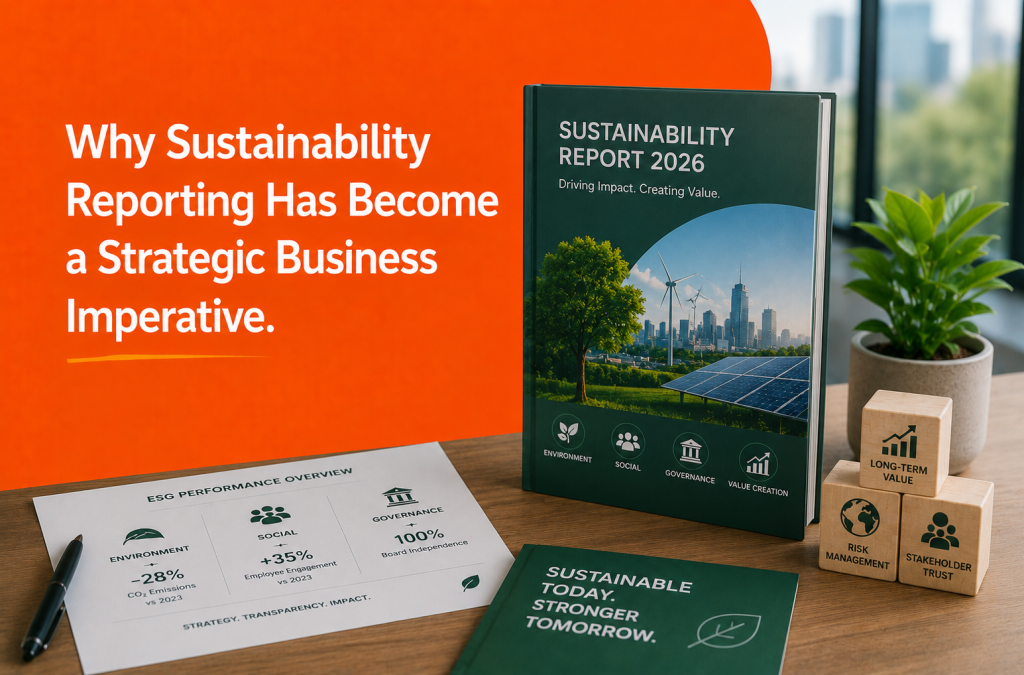
Why Sustainability Reporting Has Become a Strategic Business Imperative
Not very long ago, Sustainability Reports were often viewed as supplementary corporate documents, developed primarily to meet regulatory expectations or showcase selected CSR initiatives. They existed on the sidelines of mainstream business communication, read by a limited audience and rarely influencing broader brand perception.
That reality has changed dramatically.
Today, sustainability communication sits at the centre of how organisations are evaluated by investors, customers, employees, regulators, and communities alike. Stakeholders no longer assess businesses solely on financial growth or operational scale. They are equally interested in understanding how companies are managing environmental impact, strengthening governance practices, creating social value, and preparing for a rapidly changing future.
In this evolving landscape, Sustainability Reports, ESG Reports, and Integrated Reports have become far more than compliance-led publications. They have emerged as strategic communication tools that define credibility, shape stakeholder confidence, and reflect the long-term vision of an organisation.
At Cygnus Advertising, this transformation has been visible across industries. Companies are increasingly recognising that sustainability communication is not about presenting isolated initiatives. It is about articulating purpose, demonstrating accountability, and building trust through meaningful storytelling and impactful design.
Sustainability Communication is No Longer Optional
Businesses today operate in an environment where transparency is expected, not requested.
Investors are examining climate-risk preparedness and governance structures before making decisions. Consumers are becoming more conscious about ethical sourcing, environmental practices, and corporate intent. Employees want to work with organisations that demonstrate responsibility and long-term thinking. Regulators are pushing for more detailed disclosures and measurable commitments.
As a result, companies are under increasing pressure to communicate not just what they do, but how they do it and why it matters.
This is where Sustainability Reports and ESG communication play a critical role.
A thoughtfully developed report allows organisations to showcase how sustainability is integrated into strategy, operations, culture, and future planning. It creates a structured narrative around environmental stewardship, social responsibility, ethical governance, innovation, resilience, and long-term value creation.
Most importantly, it gives stakeholders clarity.
In a world flooded with information, clarity has become one of the most valuable forms of communication.
The Challenge is Not Lack of Work; It is Lack of Narrative
Interestingly, most organisations today are already undertaking meaningful sustainability initiatives.
They are investing in renewable energy, improving resource efficiency, reducing emissions, supporting communities, strengthening diversity and inclusion, prioritising employee well-being, and embedding stronger governance systems.
The real challenge often lies in how these efforts are communicated.
Many reports become overloaded with fragmented information, technical language, and excessive data tables that dilute the larger story. While disclosures and metrics are important, stakeholders do not engage with numbers alone. They engage with context, direction, and authenticity.
A strong Sustainability Report should answer deeper questions:
What does the organisation stand for?
How is sustainability shaping business decisions?
What progress has been made?
What challenges still exist?
How is the company preparing for the future?
This is where strategic storytelling becomes essential.
At Cygnus Advertising, report development begins with understanding the larger narrative behind the data. Before design systems, visual themes, or layouts are explored, the focus remains on identifying the central idea that connects the organisation’s sustainability journey; because the most impactful reports are not built as collections of disconnected sections. They are built around a cohesive story.
ESG Reporting Requires Strategic Communication Thinking
One of the biggest misconceptions about ESG Reports is that they are purely technical documents.
In reality, they are communication assets.
Every section within a report contributes to how stakeholders perceive the organisation. The tone, structure, language, visual hierarchy, and narrative flow all influence readability and credibility. An effective report therefore requires a balance between technical accuracy and human engagement.
It must simplify complex concepts without oversimplifying substance. It must remain data-driven while still feeling approachable. It must be comprehensive without becoming overwhelming. This balance is where stakeholder communication agencies bring value.
At Cygnus Advertising, ESG communication is approached not merely as content development or report design, but as an exercise in strategic positioning. Every report is shaped to align with the organisation’s industry, stakeholder expectations, leadership priorities, and long-term vision.
The objective is not simply to present information. The objective is to create understanding.
Design Has Become Central to Sustainability Communication
The role of design within Sustainability and Integrated Reports has evolved significantly over the years. Earlier, design was often treated as a finishing layer added after content compilation. Today, design plays a far more strategic role.
It influences how information is consumed, interpreted, and retained.
Dense pages filled with excessive text can disengage readers regardless of how strong the content may be. On the other hand, thoughtful layouts, intuitive navigation, strong visual hierarchy, thematic storytelling, and infographic-led communication can significantly improve stakeholder engagement.
Effective ESG and Integrated Report design transforms complexity into clarity. It helps present performance indicators in a digestible format. It improves accessibility for diverse stakeholder groups. It creates emotional resonance while maintaining professionalism and credibility.
At Cygnus Advertising, design is never viewed as decoration. It is viewed as communication architecture.
Every visual element, whether a cover concept, section opener, infographic system, iconography style, or typography treatment, is developed to strengthen the report’s narrative and enhance readability.
This integration of strategy, content, and design is what gives modern Sustainability Reports their impact.
Different Stakeholders Read Reports Differently
One of the most nuanced aspects of sustainability communication is the diversity of its audience.
A Sustainability Report is rarely read from a single perspective.
Investors may focus on governance frameworks, risk mitigation strategies, and long-term resilience. Employees may look for workplace culture, diversity initiatives, and leadership intent. Customers may assess ethical sourcing practices and environmental responsibility. Regulators may examine disclosures, compliance alignment, and measurable targets.
This means reports need to operate on multiple levels simultaneously.
They need to provide depth without losing accessibility. They need to communicate strategic intent while remaining transparent and grounded.
Most importantly, they need to feel credible.
Today’s stakeholders are increasingly sensitive to exaggerated sustainability messaging or superficial positioning. Overstatement weakens trust far more quickly than acknowledging areas that are still evolving.
Authenticity has therefore become one of the most important aspects of ESG communication.
The strongest reports are not necessarily the ones claiming perfection. They are the ones demonstrating commitment, progress, accountability, and self-awareness.
The Growing Relevance of Integrated Reporting
Another major shift in corporate communication is the growing importance of Integrated Reports.
Businesses today understand that sustainability can no longer exist as a separate conversation detached from operational and financial performance. ESG considerations are directly influencing investment decisions, risk assessments, supply chain strategies, talent retention, and brand reputation.
Integrated Reporting reflects this reality by connecting financial and non-financial performance into one cohesive narrative.
Rather than treating sustainability as an isolated function, integrated reports demonstrate how environmental, social, and governance priorities contribute to long-term business value creation.
However, developing an effective Integrated Report requires more than combining financial and sustainability sections into a single document.
It requires narrative alignment.
The business strategy, sustainability priorities, leadership messaging, design language, and stakeholder communication approach all need to work cohesively.
Without that alignment, reports risk feeling fragmented and inconsistent.
This is why companies increasingly rely on specialised stakeholder communication agencies that understand both reporting frameworks and narrative development.
The Future of Corporate Reporting
Sustainability communication is entering a new phase.
Reports are no longer static publications created once a year and archived digitally. They are becoming extensions of corporate identity and reputation management.
Stakeholders now expect continuity between Sustainability Reports, annual reports, investor communication, leadership messaging, digital platforms, and brand narratives.
This means organisations must communicate sustainability consistently across every touchpoint.
The future of ESG communication will belong to companies that prioritise clarity over complexity, authenticity over exaggeration, and meaningful storytelling over generic messaging.
Because ultimately, stakeholders do not connect with frameworks alone.
“They connect with intent.
They connect with transparency.
They connect with organisations that communicate responsibility with sincerity and confidence.”
At Cygnus Advertising, sustainability reporting is viewed as an opportunity to create that connection — thoughtfully, strategically, and meaningfully. In today’s business environment, communication is no longer just about sharing performance. It is about shaping perception, building trust, and defining the future narrative of the organisation itself.
Recent Post
The trends redefining corporate disclosure – what large corporates need in a partner
From Compliance to Competitive Advantage: How Strategic CSR Reporting Drives Business Value
From Spend to Story: Making India's CSR Reports Work Harder
CSR Report: Communicating Impact through Purpose-driven Reporting and Effective Design