


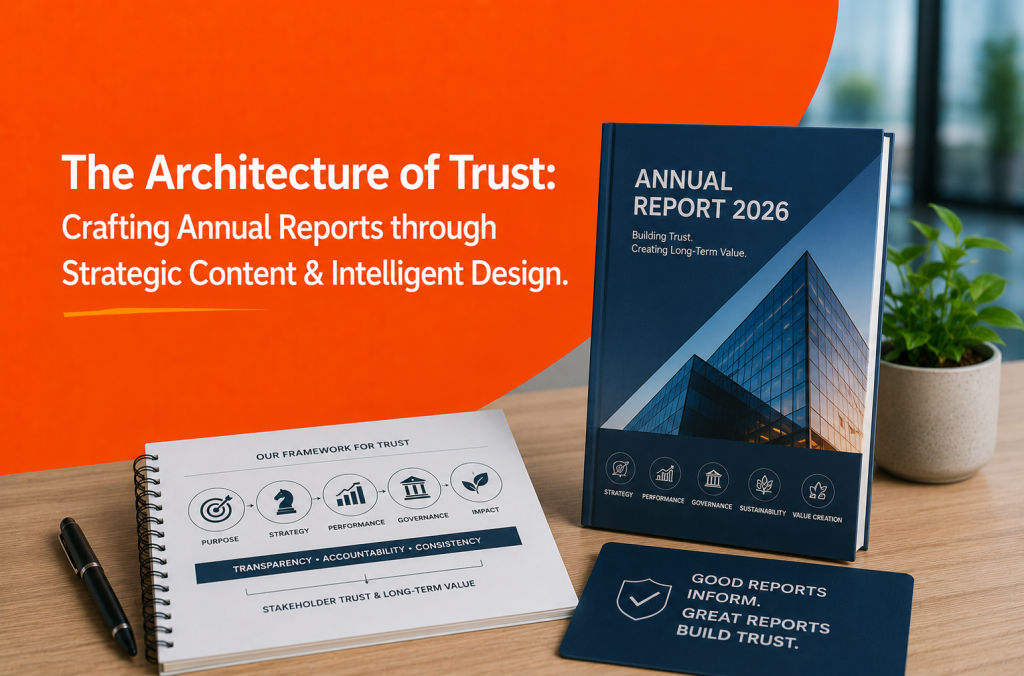
The Architecture of Trust: Crafting Annual Reports through Strategic Content & Intelligent Design
An Annual Report is no longer a Statutory Publication confined to Financial Disclosures and Compliance Narratives. It has evolved into one of the most influential strategic communication tools for organisations. Investors evaluate credibility through it. Stakeholders interpret direction and governance through it. Employees understand organisational purpose through it. Markets measure stability, growth, innovation, and transparency through every page.
In today’s highly scrutinised business environment, the Annual Report is not merely a Document of Record. It is the Narrative of an Organisation’s Vision, Resilience, Performance, and Future Readiness.
At Cygnus Advertising, we approach Annual Report Development as a blend of Strategic Storytelling, Data Intelligence, Editorial Precision, and Design-led Communication. Our Methodology is rooted in the belief that a compelling Annual Report should not just present numbers — it should contextualise Performance, humanise Leadership, and inspire Stakeholder Confidence.
Why Annual Reports need Strategic Storytelling
Many organisations still treat Annual Reports as compilation exercises driven primarily by Financial Disclosures and Templated Layouts. The result is often a document that informs but fails to engage.
An effective Annual Report must do more than comply with Regulatory Expectations. It should communicate:
- Where the Organisation stands Today
- How it navigated Challenges
- What Value it created
- Why Stakeholders should Trust its future direction
This requires a Content-first Approach.
Before Design begins, we focus on Narrative Architecture. We study the Organisation’s strategic priorities, operational milestones, leadership vision, industry landscape, and stakeholder expectations. Every section is then developed with a clear communication objective.
The Annual Report becomes not merely a summary of activities, but a carefully curated Corporate Narrative.
Understanding the Core Structure of an Annual Report
An impactful Annual Report follows a thoughtfully layered structure where each section contributes to a larger strategic narrative.
1. Chairman’s Message & Leadership Communication
The opening leadership communication sets the tone for the entire report. It should reflect confidence, accountability, vision, and realism.
Rather than generic optimism, stakeholders today expect:
- Perspective on economic and industry challenges
- Strategic decisions undertaken during the year
- Organisational achievements and setbacks
- Future growth priorities
- Commitment towards governance and sustainability
A well-crafted Chairman’s Message creates emotional credibility while aligning stakeholders with the Company’s long-term aspirations.
2. Corporate Overview & Organisational Identity
This section establishes the Company’s Positioning, Legacy, Operational Footprint, and Strategic Philosophy.
An engaging Corporate Overview typically includes:
- Company Profile
- Vision, Mission & Values
- Business Verticals
- Operational Highlights
- Geographic Presence
- Key Milestones
- Competitive Strengths
- Market Positioning
At Cygnus Advertising, we ensure this section is concise yet visually immersive, allowing readers to quickly understand the Organisation’s Scale, Purpose, and Business Ecosystem.
3. Industry Landscape & Market Insights
Stakeholders increasingly evaluate how well an Organisation understands its external environment.
This section should not simply present market statistics. It should demonstrate:
- Industry Awareness
- Strategic Adaptability
- Emerging Opportunities
- Risk Preparedness
- Competitive Intelligence
Strong Annual Reports contextualise organisational performance against macroeconomic and sectoral realities, helping investors interpret growth trajectories more meaningfully.
4. Management Discussion & Analysis (MD&A)
The MD&A section acts as the intellectual core of the Annual Report.
This is where the Organisation explains:
- Operational Performance
- Business Segment Analysis
- Revenue Drivers
- Cost Structures
- Opportunities and Threats
- Risk Management Frameworks
- Future Outlook
The language here must balance technical accuracy with readability. Overly complex financial jargon weakens stakeholder engagement. Clear analytical storytelling strengthens investor trust.
Our editorial team focusses on transforming dense operational information into coherent strategic insights that remain accessible to diverse stakeholder groups.
5. ESG, Sustainability & CSR Integration
Modern Annual Reports are increasingly evaluated through ESG and Sustainability lenses.
Stakeholders now expect clarity on:
- Environmental Impact
- Social Initiatives
- Diversity and Inclusion
- Employee Wellbeing
- Governance Structures
- Ethical Business Practices
- Community Engagement
Rather than isolating CSR as a standalone section, contemporary reporting integrates sustainability into the broader business narrative, demonstrating how responsible practices contribute to long-term value creation.
This Integration significantly enhances Institutional Credibility and Brand Reputation.
6. Financial Statements & Performance Highlights
Financial Disclosures remain central to annual reporting, but presentation plays a critical role in comprehension.
The challenge lies in simplifying complexity without compromising accuracy.
We emphasise:
- Clean Financial Hierarchy
- Comparative Visual Data
- Infographics for Key Metrics
- Multi-year Performance Snapshots
- Ratio Analysis
- Shareholder Insights
Well-designed financial storytelling enables readers to absorb critical information quickly while reinforcing transparency and governance standards.
Design as a Strategic Communication Tool
Annual Report Design is not decoration. It is functional communication.
At Cygnus Advertising, Design begins with Information Architecture. Every visual decision is guided by Readability, Hierarchy, Engagement, and Brand Consistency.
Creating Visual Narrative Flow
An Annual Report should feel seamless from one section to another.
We build visual continuity through:
- Structured Grids
- Consistent Typography
- Section Dividers
- Visual Storytelling Devices
- Data Visualisation Systems
- Iconography Frameworks
- Image-led Transitions
This creates rhythm, allowing readers to navigate extensive information without fatigue.
Infographics that Simplify Complexity
Large volumes of financial and operational information can overwhelm readers when presented only through tables.
Our design teams develop:
- Growth Charts
- Timeline Infographics
- Operational Dashboards
- Geographic Maps
- Business Ecosystem Illustrations
- KPI Visual Summaries
These elements transform complex data into digestible visual insights.
Effective Infographics improve Retention, Comprehension, and Stakeholder Engagement.
Photography & Visual Authenticity
Authenticity is central to Corporate Credibility.
Rather than relying excessively on stock visuals, impactful Annual Reports increasingly use:
- Real Workplace Imagery
- Leadership Interactions
- Manufacturing Facilities
- Employee Engagement Moments
- Community Outreach Visuals
- Operational Environments
These Visuals humanise the Organisation and reinforce Trust.
Photography in Annual Reports should not merely beautify pages — it should validate the narrative being communicated.
Digital-First Annual Reporting
Annual Reports are no longer consumed only in Print.
Stakeholders increasingly access reports through:
- Interactive PDFs
- Corporate Websites
- Mobile Devices
- Investor Dashboards
- Microsites
- Digital Presentations
This requires Responsive Design Thinking.
Digital-first Reporting strategies include:
- Clickable Navigation
- Interactive Charts
- Embedded Multimedia
- Animated Transitions
- Search-friendly Structures
- Modular Content Layouts
The shift towards Digital Reporting has transformed Annual Reports into dynamic Stakeholder Communication Platforms rather than Static Publications.
The Importance of Editorial Integrity
Credibility defines the effectiveness of an Annual Report.
Stakeholders can easily identify exaggerated claims, inconsistent messaging, or superficial storytelling.
Strong Annual Reporting therefore prioritises:
- Fact Verification
- Data Consistency
- Regulatory Alignment
- Editorial Coherence
- Tonal Uniformity
- Governance Transparency
At Cygnus Advertising, editorial integrity forms the backbone of every reporting project. We ensure that narrative ambition is always balanced by factual accountability.
Annual Reports as Brand-Building Assets
A thoughtfully crafted Annual Report strengthens far more than Investor Relations.
It enhances:
- Corporate Reputation
- Employer Branding
- Stakeholder Trust
- Institutional Credibility
- Market Perception
- Industry Positioning
When executed strategically, the Annual Report becomes one of the most powerful manifestations of Organisational Identity.
It communicates not only what the Company achieved — but what it stands for.
Annual Reporting today demands far more than Compliance-driven Documentation. It requires clarity of purpose, narrative intelligence, visual sophistication, and stakeholder-centric communication.
At Cygnus Advertising, we combine strategic content development, editorial expertise, research-driven storytelling, and impactful design systems to create Annual Reports that Inform, Engage, and inspire Confidence. By transforming financial and operational information into compelling corporate narratives, we help Organisations elevate Annual Reporting from a mandatory exercise into a strategic communication asset that builds Trust, strengthens Reputation, and reflects Long-term Vision.
Recent Post

The trends redefining corporate disclosure – what large corporates need in a partner

From Compliance to Competitive Advantage: How Strategic CSR Reporting Drives Business Value

From Spend to Story: Making India's CSR Reports Work Harder
CSR Report: Communicating Impact through Purpose-driven Reporting and Effective Design