


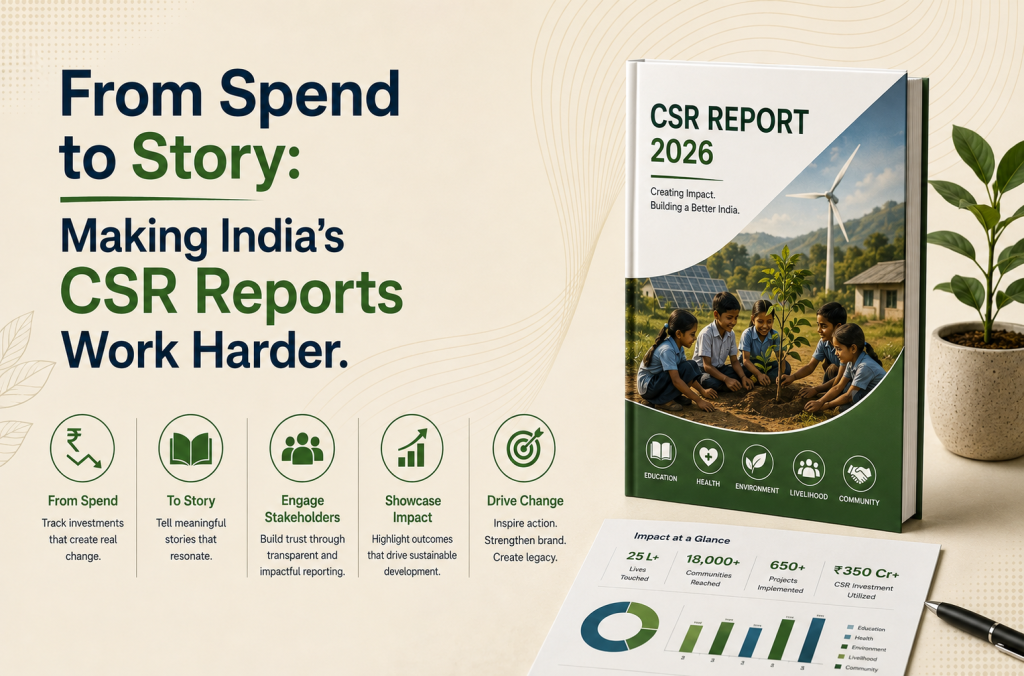
From Spend to Story: Making India’s CSR Reports Work Harder
A few months ago, the head of sustainability at a mid-sized manufacturing company sat across from her board with a number she was proud of. Her company had spent its full two percent, funded three schools, a rural health programme, and a watershed project across two districts. The chairman studied the slide, nodded, and asked one question that quietly changed how she thought about her job.
– “This tells me what we spent. What did it change?”
She did not have a clean answer. And on that count, she has plenty of company.
India runs the largest mandated CSR programme anywhere in the world, and the numbers keep climbing. In FY2024-25, companies spent a record ₹40,794 crore on CSR, a seventeen percent jump over the previous year, spread across 29,546 companies and more than 72,000 projects. Over the last decade, corporate India has channelled upward of ₹2.61 lakh crore into social spending. Education took the largest share at thirty-four percent, healthcare followed at twenty-one percent, and environmental work, though smaller in absolute terms, grew the fastest at forty percent year on year.
That is a staggering amount of money doing real work on the ground. Yet for most companies, the CSR Report that captures all of it still reads like a receipt. A list of activities, a table of amounts, a grid of photographs at cheque handovers. The spend is documented. The story is missing.
This is the quiet shift now underway in Indian boardrooms. CSR began as a compliance exercise under Section 135 of the Companies Act, and for years that framing was enough. File the report, tick the box, move on. But the audience for that report has grown well beyond the Ministry. Investors reading BRSR disclosures, the top 1,000 listed companies now reporting under SEBI’s expanded framework, employees choosing where to build a career, customers deciding what to buy, and regulators asking sharper questions each year. Every one of them reads the CSR Report as a signal of how a company thinks, not merely how it spends.
That is precisely where business value enters the picture. A well-made CSR Report is no longer a cost of doing business. It is a brand asset, a recruitment tool, an investor relations document, and a trust-building exercise folded into one. Companies that treat it that way are pulling ahead. Companies that treat it as paperwork are leaving that value on the table, year after year.
The regulator saw the same gap. Since 2021, any company with an average CSR obligation of ₹10 crore or more must commission an independent impact assessment for every project above ₹1 crore that has run for at least a year. The findings go to the board and are annexed to the CSR Report, and the company can even book the cost of the study as CSR spend, up to the higher of ₹50 lakh or two percent of its outlay.
On paper this reads as one more compliance rule. In practice it may be the most useful thing to happen to Indian CSR in a decade, because it forces exactly the question that chairman asked. What changed? Impact assessment is how a company moves from counting inputs, the money spent and the beneficiaries reached, to measuring outcomes, the incomes lifted, the school attendance improved, the water table recharged. Some organisations go a step further with Social Return on Investment, a method that assigns a rupee value to social outcomes, so a project can credibly claim that every rupee spent created ₹4 of social worth.
The evidence exists now, sitting in assessment reports across the country. What most companies still lack is the ability to turn that evidence into something people actually want to read.
Here is the real opportunity, and it has two parts.
The first is Impact Reporting done properly. Not a longer document, a clearer one. Good Impact Reporting connects money to method to outcome, so a reader can follow a single thread from the budget line to the family whose life it touched. It leans on baselines and comparisons rather than raw totals. It is honest about what did not work, which, oddly enough, is what makes readers trust everything else on the page.
The second is Impact Storytelling. Numbers earn credibility, but stories earn memory. The strongest CSR reports pair a hard metric with a human moment, the figure that proves the scale beside the face that proves it matters. Impact Storytelling is not decoration bolted on at the end. It is the discipline of finding the one true narrative buried inside a spreadsheet and building the report around it.
Holding both of these together is designing a CSR Report. Design here has little to do with a prettier cover. It is the architecture of the whole document — how data is visualised, how a reader’s eye travels down a page, how a dense assessment table becomes a chart anyone can grasp in five seconds, how a case study is given room to breathe. Strong CSR Report Design is what makes a hundred pages of genuine impact feel like a story worth an hour of someone’s attention rather than a duty to be skimmed and shelved.
This is exactly where Cygnus Advertising brings its strength to the table –
At the intersection of data, insight and design.
For close to a decade, Cygnus has produced investor-grade reports, brand narratives, and sustainability communications for clients across FMCG, pharma, real estate, financial markets, and institutional sectors. That combination is genuinely rare in this landscape. Most impact assessment firms can measure but cannot tell the story. Most design studios can make a page beautiful but do not know a materiality matrix or a BRSR disclosure. Cygnus sits precisely at the join, fluent in the data and the narrative at the same time.
At Cygnus, a CSR Report begins with the evidence, the assessment findings and the metrics that actually matter, and shapes it into Impact Reporting that a board member, an institutional investor, and a village elder could each recognise as true. It brings Impact Storytelling that respects the reader’s intelligence, and CSR Report Design that carries the meaning rather than dressing it up. The result is a document that does far more than satisfy a filing requirement. It builds reputation, attracts talent, reassures capital, and earns the very trust the spending was meant to create.
Return, for a moment, to that sustainability head and her chairman’s question. What changed? The honest answer to that question is the most valuable thing a company can publish. The spending is already happening; at a scale few countries can match. The work is real.
What remains is to “Tell it Well”. That is the whole difference between a report that gets filed and one that gets remembered. And it is the difference Cygnus helps its clients make.
Recent Post
The trends redefining corporate disclosure – what large corporates need in a partner
From Compliance to Competitive Advantage: How Strategic CSR Reporting Drives Business Value
From Spend to Story: Making India's CSR Reports Work Harder
CSR Report: Communicating Impact through Purpose-driven Reporting and Effective Design