


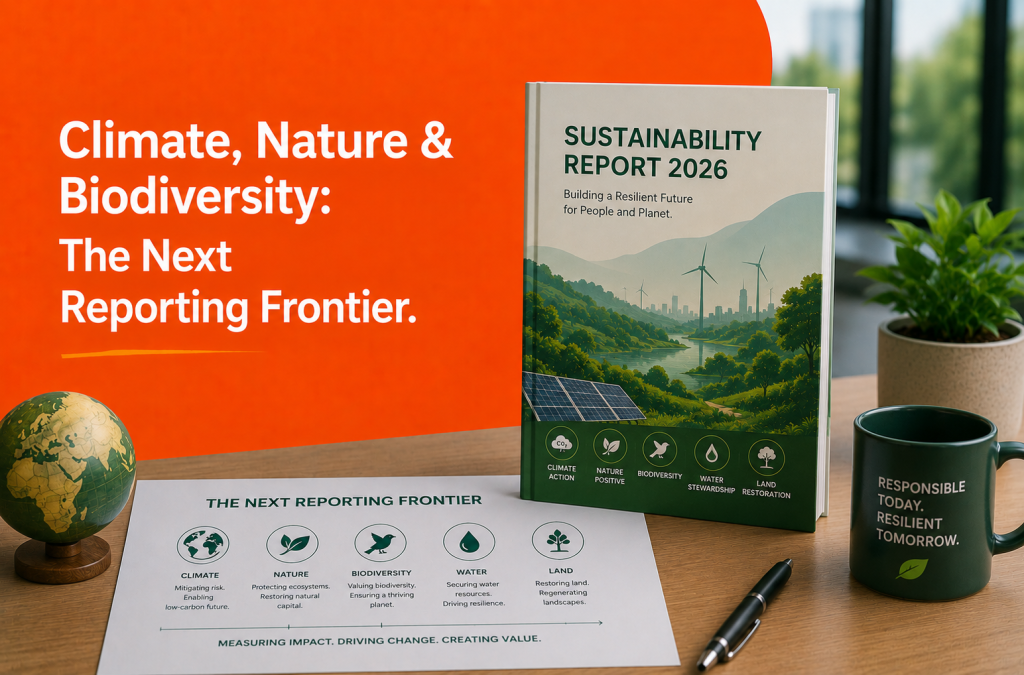
Climate, Nature & Biodiversity: The Next Reporting Frontier
A few years ago, climate change dominated every boardroom conversation.
Companies spoke about carbon emissions, net-zero commitments, renewable energy transitions, and climate resilience. Sustainability reports grew thicker, ESG disclosures became more detailed, and climate risk reporting evolved from a niche concern into a mainstream business priority.
Today, however, a new question is emerging around board tables across the world:
What happens when nature itself becomes a business risk?
Imagine a manufacturing facility facing operational disruptions because of water scarcity. Consider a food company struggling with declining agricultural yields due to ecosystem degradation. Think about a supply chain affected by the loss of pollinators, forests, wetlands, or healthy soil systems. These are no longer hypothetical scenarios. They are business realities.
As organizations strengthen their climate risk reporting frameworks, a broader frontier is coming into focus, one that encompasses biodiversity, ecosystems, natural capital, and nature-related disclosures. Under evolving global sustainability standards and ISSB guidance, businesses are increasingly expected to understand not only their impact on nature but also their dependence on it.
The era of climate reporting is expanding into the era of nature reporting.
The Evolution of Sustainability Reporting
For years, sustainability reporting focused on carbon emissions and climate targets. But climate and nature are inseparable. Forests, wetlands, and biodiversity play a critical role in climate resilience and business continuity.
Today, companies are looking beyond carbon to assess biodiversity risks, ecosystem dependencies, and nature-related impacts. The focus is shifting from emissions alone to a broader vision of environmental and business resilience.
Why Biodiversity Has Entered the Boardroom
Nature is no longer viewed solely as an environmental issue, it is increasingly recognized as a business and financial concern. Investors, regulators, and stakeholders want greater transparency on how companies impact ecosystems and how biodiversity loss could affect operations.
From water availability and healthy soils to resilient supply chains, businesses depend heavily on nature. As biodiversity declines, risks to operations, costs, and reputation grow. This is why biodiversity reporting is becoming a critical part of corporate sustainability strategies, helping organizations measure and communicate their relationship with nature more effectively.
Nature-Related Disclosures: The New Corporate Imperative
Much like climate-related disclosures gained prominence through frameworks such as TCFD, nature-related disclosures are now gaining momentum globally. Organizations are being encouraged to identify:
- Their dependence on natural resources
- Their impact on biodiversity and ecosystems
- Nature-related risks and opportunities
- Long-term strategies for ecosystem stewardship
Traditional ESG reporting often focused on what companies emitted. Nature-related reporting requires organizations to understand what they consume, influence, restore, and depend upon.
This broader perspective creates a more complete picture of corporate sustainability performance. Companies that proactively integrate biodiversity disclosures into their annual reports, Sustainability reports, and integrated reports are likely to strengthen stakeholder trust and demonstrate future readiness.
From Compliance to Strategic Value Creation
Leading organizations are moving beyond viewing biodiversity reporting as a compliance requirement and embracing it as a strategic advantage. Nature-related disclosures can reveal resource dependencies, operational risks, and opportunities for innovation.
Whether through water stewardship, ecosystem restoration, or sustainable sourcing, businesses can strengthen resilience while securing long-term value. In this way, biodiversity reporting becomes more than a disclosure exercise, it becomes a powerful tool for risk management, informed decision-making, and sustainable growth.
The Role of ISSB and the Future of Corporate Reporting
Global reporting standards continue to evolve toward greater consistency, comparability, and transparency.
The ISSB has accelerated discussions around sustainability-related financial disclosures, encouraging companies to consider how environmental issues affect enterprise value. As reporting expectations mature, nature, biodiversity, and ecosystem-related metrics are expected to become increasingly important components of corporate disclosure frameworks. This evolution signals a broader transformation in corporate reporting.
Investors are no longer satisfied with understanding only financial performance. They want insights into resilience, resource dependency, environmental stewardship, and long-term value creation.
The reports of the future will tell a more connected story, one that links financial outcomes with climate action, ecosystem health, and sustainable growth.
Looking Ahead
The next frontier of corporate reporting is not solely about climate. It is about understanding the intricate relationship between business and the natural world.
Climate risk reporting has already become a business necessity. Nature-related disclosures and biodiversity reporting are following closely behind. Together, they represent a more comprehensive approach to sustainability, resilience, and value creation. The organizations that lead this transition will not simply report on nature. They will recognize nature as a strategic asset, a source of resilience, and a foundation for long-term growth.
In the years ahead, the most compelling corporate reports may not just tell the story of profits and performance. They will tell the story of how businesses and nature thrive together. As climate, nature, and biodiversity become integral to corporate reporting, organizations need more than compliance-driven disclosures, they need narratives that connect sustainability performance with long-term business value. At Cygnus Advertising, we help companies transform complex ESG report, sustainability report, and integrated reporting data into clear, impactful, and stakeholder-focused reports. By combining strategic content, insightful storytelling, and world-class report design, we enable organizations to communicate their commitment to climate resilience, biodiversity stewardship, and sustainable growth with clarity, credibility, and confidence.
Recent Post

From Compliance to Competitive Advantage: How Strategic CSR Reporting Drives Business Value
From Spend to Story: Making India's CSR Reports Work Harder
CSR Report: Communicating Impact through Purpose-driven Reporting and Effective Design
Annual Report Design Services: Transforming Corporate Performance into Powerful Brand Stories