


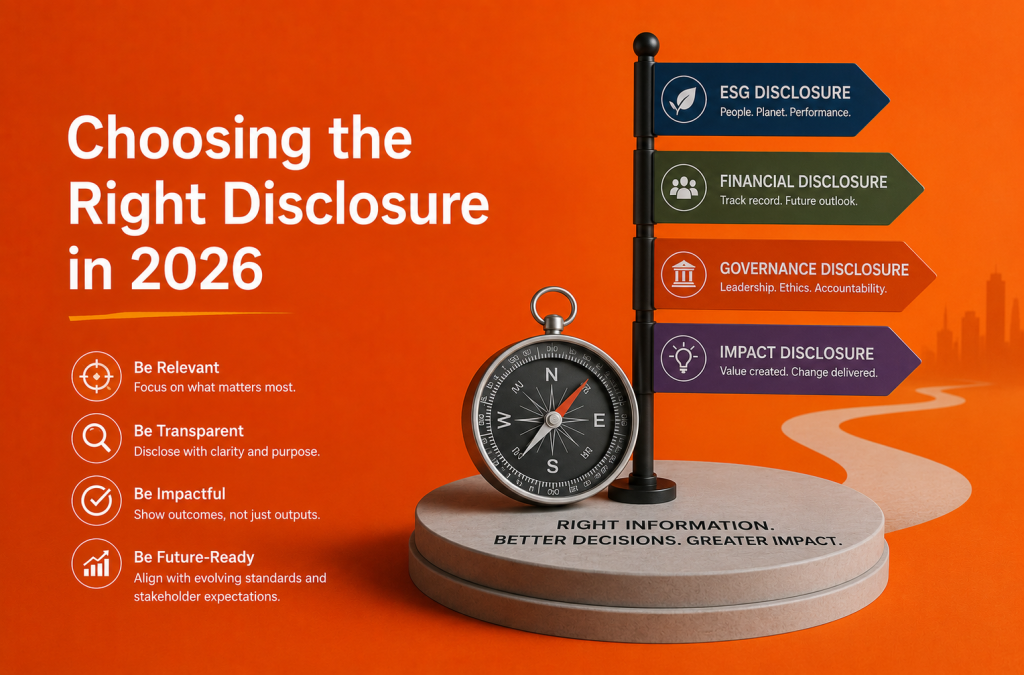
Choosing the Right Disclosure in 2026
Every year, sometime between May and August, the same conversation happens in boardrooms across India. The Company Secretary checks a compliance list. The CFO wants to know the regulatory exposure. The Chief Communications Officer is caught between what legal demands and what investors expect. And someone, usually the most honest person in the room, asks the question that nobody wants to be the one asking: Are we doing a CSR Report, an ESG Report, a Sustainability Report, or an Integrated Report? And what exactly is a BRSR? Is it the same thing? Do we need all of them?
This confusion is not a sign of negligence. It is a predictable consequence of a reporting landscape that has grown faster than most companies’ ability to keep pace with it. What was once a single voluntary disclosure, a modest CSR brochure with community photographs and a message from the Chairman, has fractured into an entire ecosystem of report types, each carrying its own regulatory weight, audience expectation, and communication purpose. In 2026, getting this wrong is not just operationally inefficient. It is a reputational and compliance risk that companies can no longer afford to treat casually.
This blog sets out to resolve that confusion, clearly, completely, and practically.
Why the Landscape has become so Complex
The proliferation of report types is a direct consequence of how sharply stakeholder expectations have evolved. Global frameworks like the GRI Standards, the Task Force on Climate-Related Financial Disclosures (TCFD), SASB, and the IFRS Sustainability Disclosure Standards developed by the ISSB have each created their own vocabulary, scope, and disclosure requirements. India has then layered its own mandatory framework on top of this global architecture: SEBI’s Business Responsibility and Sustainability Report (BRSR), the Companies Act’s CSR disclosure provisions, and the broader integrated reporting movement championed by the IFRS Foundation.
The result is a situation where a company today may legitimately be expected to produce a CSR Report under the Companies Act, a BRSR under SEBI mandate, an ESG Report for institutional investors, a Sustainability Report for GRI-aligned global stakeholders, and an Integrated Annual Report for holistic corporate communication. Every single one of these documents is different in scope, audience, tone, and regulatory status. Some overlap substantially. Some partially replace each other. Only some are legally compulsory. And very few companies have received a clear, working explanation of how they relate to one another.
That is what follows.
CSR Report: Compliance with a Story to Tell
The Corporate Social Responsibility Report is the oldest and, in India, the most clearly regulated of all non-financial disclosures. Under Section 135 of the Companies Act 2013, companies that cross specified thresholds of net worth, turnover, or net profit are required to spend two percent of their average net profit on CSR activities and to report on those activities in the Board’s Annual Report. The CSR Report, in its basic form, is that disclosure: what was spent, on which initiatives, with what intended and measured impact.
Its primary audience is regulators, community stakeholders, NGO partners, employees, and local press. Its scope is intentionally narrow. It focuses on philanthropic and community investment activity, and it does not typically include environmental performance data or governance disclosures in meaningful depth. What it is not, and what many companies mistakenly treat it as, is a substitute for a full ESG disclosure.
The strategic opportunity here is consistently underused. A CSR Report that merely satisfies the compliance requirement looks exactly like a compliance requirement. Companies that understand the difference between reporting and communicating invest in real narrative within the CSR Report: project case studies, beneficiary voices, ground-level photography, and measurable outcome data that turns what could be a regulatory checkbox into a genuine demonstration of purpose. As research shows, over 60% of people now expect CEOs to address societal issues beyond profits, and the CSR Report is often a company’s most direct public statement of how it is doing exactly that.
Sustainability Report: Data at Scale, Strategy at the Centre
A Sustainability Report is broader in scope, voluntary in India, and typically aligned with the GRI Standards, the most widely adopted sustainability reporting framework globally, used by organisations in over 100 countries. Where a CSR Report focuses on social investment, a Sustainability Report covers the full breadth of a company’s environmental, social, and governance performance across its operations and, increasingly, its value chain.
The audiences for a Sustainability Report extend well beyond domestic regulators. Global institutional investors, ESG rating agencies, international supply chain partners, sustainability-focused consumers, and multinational procurement teams all use Sustainability Reports to evaluate a company’s non-financial performance. For Indian companies with export relationships, foreign institutional investment, or aspirations to attract global capital, a credible, GRI-aligned Sustainability Report has ceased to be optional in any practical sense.
What distinguishes a strong Sustainability Report is its command of data and its ability to translate that data into a coherent narrative. It quantifies emissions (Scope 1, 2, and increasingly Scope 3), energy and water consumption, waste generation, biodiversity impact, supply chain ethics, labour practices, diversity and inclusion metrics, and governance structures. The design challenge is considerable. This is a document that carries an enormous data burden and must make that data legible, credible, and compelling to a technically literate but time-pressed audience. Poorly designed sustainability reports, those that bury critical metrics in unformatted tables or string together dense paragraphs of framework language, send a signal to stakeholders that the company’s commitment to sustainability is as surface-level as the document itself.
ESG Report: Investor-grade Disclosure
An ESG Report is, in many ways, the investor-facing version of a Sustainability Report. The distinction is one of primary audience and communication intent. Where a Sustainability Report speaks broadly to multiple stakeholder groups and is built to demonstrate operational commitment to responsible business conduct, an ESG Report is designed specifically to satisfy the information needs of financial stakeholders: institutional investors, ESG rating agencies such as MSCI, Sustainalytics, and CRISIL, asset managers, credit analysts, and debt and equity investors who are increasingly required by their own mandates to assess portfolio companies on ESG criteria.
ESG Reports prioritise comparability and standardisation. The metrics covered, environmental (Scope 1, 2, and 3 emissions, climate risk exposure, energy intensity), social (gender pay gap, safety incident rates, employee turnover, community investment), and governance (board independence, executive compensation structure, anti-corruption policies, whistleblower mechanisms), are presented in formats that rating agencies and analysts can directly benchmark against sector peers and global indices.
The design discipline required for an ESG Report reflects this. The audience is analytically sophisticated but operates under real time constraints. Clean data visualisation, consistent colour coding by pillar, a clear navigational architecture that allows a fund manager to locate the metrics they need in under two minutes. These are not aesthetic preferences. They are functional requirements that determine whether the report actually gets used or filed and forgotten.
BRSR: India’s Mandatory ESG Framework
The Business Responsibility and Sustainability Report is India’s own structured framework for ESG disclosure, introduced by SEBI in 2021 and made compulsory from FY 2022–23 for the top 1,000 listed companies by market capitalisation. Filed alongside the Annual Report on the BSE and NSE portals, the BRSR is not a voluntary gesture. It is law for the companies it covers.
The framework is built on nine principles drawn from SEBI’s National Guidelines for Responsible Business Conduct (NGRBC), spanning ethical conduct, product responsibility, employee wellbeing, environmental stewardship, human rights, and policy advocacy. It requires approximately 140 quantifiable data points, a transformation from the 36 largely qualitative questions of the Business Responsibility Report (BRR) it replaced. This shift, as industry observers consistently note, represents a fundamental change in how corporate sustainability is measured in India: from narrating policies to quantifying outcomes, from qualitative intent to verifiable ESG performance.
In the current cycle, SEBI has extended BRSR Core disclosure requirements to value chain partners of listed entities, widening the accountability perimeter significantly. The terminology around verification has also been refined, from “assurance” to “assessment or assurance,” to balance the integrity of independent validation with practical compliance realities for a broader set of organisations.
The critical strategic insight for 2026 is this: BRSR compliance and BRSR communication are not the same thing. A technically complete BRSR submission that is buried in the appendix of an Annual Report, formatted as a dense disclosure matrix, and treated as a legal obligation rather than a stakeholder communication, is a missed opportunity of considerable proportions. The most effective corporate reporting agencies, including Cygnus, understand that the BRSR must be contextualised, visualised, and integrated into the Annual Report’s broader narrative if it is to function as the strategic asset it is capable of being.
Integrated Annual Report: The Full Picture
The Integrated Annual Report is the most comprehensive and strategically sophisticated of all the report formats under discussion. Guided by the International Integrated Reporting Framework developed by the IFRS Foundation, an Integrated Report brings together financial performance, non-financial performance, ESG commitments, governance structures, strategic direction, and long-term value creation into a single, coherent document structured around a central question: how does this organisation create value, financially, socially, environmentally, and for all its stakeholders, over the short, medium, and long term?
The philosophical foundation of Integrated Reporting is the six capitals model: Financial, Manufactured, Intellectual, Human, Social and Relationship, and Natural Capital. A well-constructed Integrated Report shows how the company draws on, transforms, and returns value across all six, rather than reporting financial performance in isolation from the environmental, human, and social resources that make that performance possible.
For listed companies and large-cap organisations communicating with institutional investors, the Integrated Annual Report has rapidly become the expected standard rather than a differentiator. Companies across industries (manufacturing, financial services, energy, FMCG, infrastructure) are adopting the format because it satisfies the most demanding of all stakeholder demands simultaneously. It gives investors the financial rigour they require, gives ESG analysts the sustainability data they track, gives governance-focused shareholders the accountability narrative they expect, and gives employees, communities, and partners the sense that the company sees their interests as structurally connected to its own.
The design requirements of an Integrated Report are correspondingly high. The thematic spine of the report, the single strategic idea that connects every section, must be earned through deep engagement with the company’s actual year, not grafted on as a slogan. The data visualisation system, the typography, the photography direction, the infographic architecture, and the financial data presentation must all serve the same narrative purpose. This is not a document that can be assembled in isolation by a financial reporting team and handed to a designer at the end of the process.
The Convergence that Changes Everything
In 2026, the most important thing to understand about these five report types is that they are converging. The trajectory of both global regulation and Indian regulatory reform is towards a single, unified disclosure that integrates financial and non-financial performance, quantitative data and strategic narrative, backward-looking results and forward-looking strategy, all within one coherent annual communication. SEBI’s BRSR mandate is India’s on-ramp to that destination. The ISSB’s Sustainability Disclosure Standards are the global highway.
Companies that continue treating their CSR Report, Sustainability Report, ESG disclosure, and Annual Report as separate, siloed documents produced by different teams at different times are not just creating internal operational inefficiency. They are creating a fragmented stakeholder experience. Investors receive one version of the company’s story. Regulators receive another. Communities and employees receive a third. The cumulative effect is an organisation that appears to have multiple identities, none of them fully credible.
An Integrated Annual Report is the answer to that fragmentation. But the report itself is only the visible output of a much deeper process: a process that requires consulting expertise, gap analysis, and design integration working as one. That is where the choice of partner becomes the most consequential decision in the entire reporting cycle.
Cygnus: Your Value Chain Partner for Strategic Corporate Reporting
In 2026, companies do not need another vendor. They need a value chain partner. The distinction is fundamental. A vendor is engaged at the end of the process to execute a brief. A value chain partner is embedded from the beginning, shaping the strategy, identifying the gaps, building the architecture, and delivering the final document as part of a single, integrated workflow.
Where the conventional model fragments corporate reporting across multiple providers (a sustainability consultant for the framework, an ESG advisor for the metrics, a creative agency for the design, a print vendor for the production, a digital team for the website adaptation), Cygnus delivers all of it under one roof. One strategic vision. One project team. One accountability framework. One quality standard. One partner across the entire value chain.
Our value chain partnership operates across three integrated dimensions, each indispensable, each delivered by a single team.
1. Consulting: Strategy before deliverables
Cygnus advises companies on which reports they actually need, which frameworks apply, and how to position their disclosures strategically. Whether a client is preparing its first BRSR, building a GRI-aligned Sustainability Report for international stakeholders, or pursuing an Integrated Annual Report to consolidate its corporate narrative, we begin with strategy, not deliverables. Our consulting work covers materiality analysis, ESG narrative architecture, stakeholder mapping, reporting framework selection (BRSR, GRI, ISSB, TCFD, SASB), disclosure prioritisation, and the alignment of sustainability commitments with the company’s broader business strategy.
2. Gap Analysis: Knowing where you stand before you decide where to go
Before any report is written, Cygnus assesses where the company stands today against where it needs to be. This gap analysis covers four critical dimensions: data readiness (what is measured, what is estimated, and what is missing entirely), governance maturity (what policies and committees exist and what is yet to be formalised), regulatory exposure (which frameworks apply to the company today, which will apply tomorrow, and what level of disclosure each demands), and communication clarity (whether the company’s existing materials actually convey what its stakeholders need to hear). The gap analysis becomes the working brief for the entire reporting cycle. It is the bridge between consulting and execution, and it is what prevents the most common failure in corporate reporting: producing a document that looks complete but is structurally hollow.
3. Design and Production: Reports that are read, not filed
Cygnus then translates strategy and data into reports that earn the attention of the audiences they are written for. Editorial direction, information design, typography, infographic architecture, photography curation, financial data visualisation, print specification, and digital adaptation are all delivered in-house. The same team that shaped the strategy shapes the visual language. The result is a report whose form is inseparable from its substance, a document where the design carries the strategic message rather than dressing it up after the fact.
Why Integration Matters
The conventional fragmentation, in which different providers handle different stages of the reporting cycle, produces predictable problems. Design teams receive content too late to influence narrative. Consultants deliver frameworks that production teams cannot execute on schedule. ESG advisors recommend disclosures that the creative team has no context to communicate effectively. The company ends up paying multiple vendors to coordinate a process that should have been integrated from the start, and the report itself reflects that fragmentation in its final form.
Cygnus eliminates that friction by occupying every position in the value chain. Strategy, gap analysis, content, design, production, and digital delivery are not handed off across providers. They are executed by one team, in one workflow, against one set of strategic objectives. The savings are not just financial. They are visible in the integrity of the final report.
We have spent over two decades doing exactly this work for leading organisations across India, across the full spectrum of corporate reports: Annual Reports, Integrated Reports, Sustainability Reports, ESG Reports, BRSRs, and CSR Reports. Our expanded in-house expertise in ESG consulting and corporate storytelling reflects a broader truth about where this industry is heading. Companies today do not simply want a report designed. They want a partner who can shape the communication strategy, identify the gaps in their current disclosures, navigate the regulatory landscape, and ensure that every report, whether mandatory or voluntary, functions as a demonstration of the organisation’s values, governance, and long-term vision.
The era of the compliance document is over. What replaces it, for the companies that understand the shift, is the era of the strategic corporate reporting. One that does not merely inform stakeholders. One that builds trust with them.
“And the one that delivers it, is not a vendor at the end of a procurement chain. It is a value chain partner, integrated from the first conversation to the final stakeholder touchpoint.”
Recent Post
The trends redefining corporate disclosure – what large corporates need in a partner
From Compliance to Competitive Advantage: How Strategic CSR Reporting Drives Business Value
From Spend to Story: Making India's CSR Reports Work Harder
CSR Report: Communicating Impact through Purpose-driven Reporting and Effective Design