


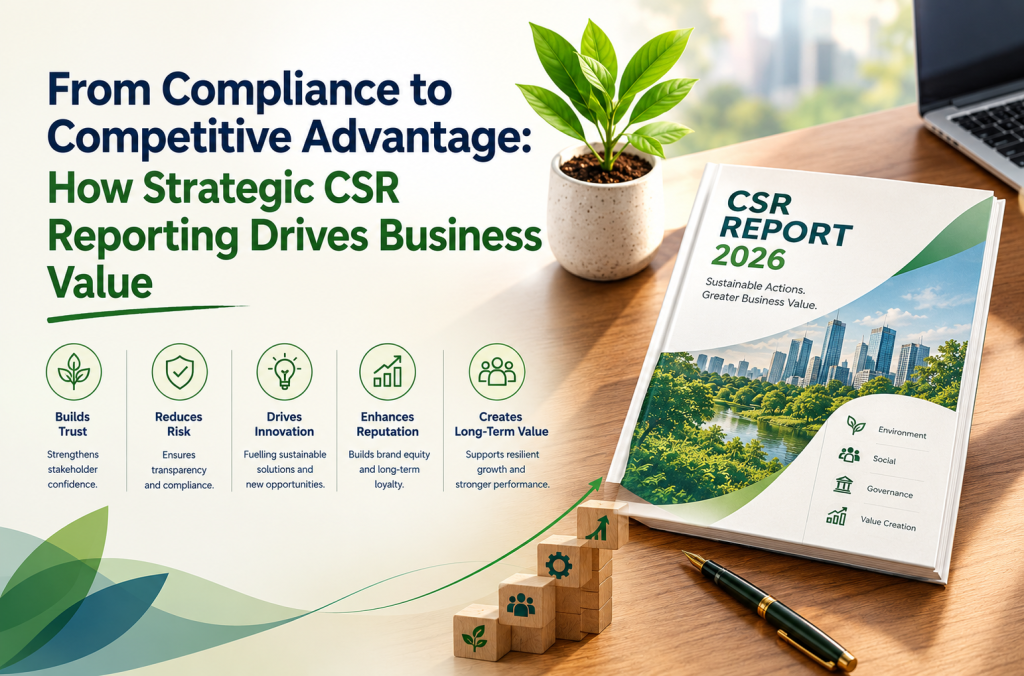
From Compliance to Competitive Advantage: How Strategic CSR Reporting Drives Business Value
For years, Corporate Social Responsibility meant hitting a Mandatory Checklist. You collected your expenditure data, passed it along to compliance or legal teams, wrapped it in a plain PDF, and filed the paperwork.
That approach is quickly losing relevance.
Today, stakeholders are asking much sharper, more analytical questions: What changed because of the intervention? Who actually benefitted? Can the impact be measured? And what does it reveal about the organisation’s long-term resilience?
Commercial returns follow when social impact becomes a core strategic priority rather than a compliance item. Research has shown that organizations with transparent and well-structured social impact initiatives can experience a 6% increase in market value and a 57% reduction in employee attrition. The real organizational value isn’t in collecting more data on operational details. It’s about intentional reporting design, clear measurement frameworks, and authentic storytelling.
The ROI of Responsibility: Why CSR Drives Real Value
When done correctly, a CSR Report moves past its traditional role as a year-end formality. It becomes a silent guide for leadership, showing where social initiatives are truly taking hold, where resources are yielding the most meaningful results, and which efforts deserve to grow.
When backed by clear, structured evidence, non-financial performance subtly strengthens three core areas of the business:
- Investor Confidence & Valuation: Transparent disclosures offer institutional investors a clearer picture of long-term risk management and operational health, which can naturally help lower the cost of capital over time.
- Talent Attraction & Retention: Younger professionals increasingly look at a company’s real-world footprint before taking a job. Having a genuine, well-documented impact strategy makes hiring easier and keeps teams engaged longer.
- Brand Reputation & Community Trust: Consistent engagement with local communities builds authentic goodwill. That trust secures your ongoing social license to operate and helps safeguard market share in the long run term.
Beyond Numbers: Master Impact Storytelling
Data lends credibility to your work, but human narrative gives it context. Saying “2,500 women were trained in entrepreneurship” shows scale but does not tell how participants gained skills, accessed finance, or improved household income.
That’s where Impact Storytelling comes in—to give context to the data without turning beneficiaries into marketing props or exaggerating the truth about success.
Instead of saying an organization spent ₹ 200,000 on clean water infrastructure, anchor the metric to real operational change:
“We invested in local water purification systems around our manufacturing centres. This reduced 120 hours of monthly downtime from waterborne diseases among local workers, increased plant productivity by 14%, and provided clean water to 3,000 households.
When you combine audited metrics with real human outcomes, impact reporting transforms disclosures from a cold financial document into a proof-of-performance case.
Driven by Relevant Data
The wider Corporate Reporting environment is moving slowly toward information that is structured, quantifiable, and comparable. Frameworks like the Business Responsibility and Sustainability Reporting (BRSR) in India, introduced by the Securities and Exchange Board of India (SEBI), are increasingly pushing disclosures toward greater accountability and transparency.
However, more data is not better data—relevant data is better. The trick is to put the metrics in a logical flow.
Strategic CSR Report Design: Turning Data into Clarity
One of the most common misconceptions is that CSR Report design is simply a matter of visual styling. Good design in practice helps people to find, understand, and remember complex information.
Designing for the Reader’s Purpose
Different stakeholders read a report in different ways. A senior executive needs a fast overview of investment returns; a board member looks for risk management; a community partner wants to understand the implementation model.
Thoughtful CSR Report Design addresses these distinct needs by putting key highlights first, using dynamic charts to show progress over the years, and offering digital features like interactive microsites or searchable sections for more details.
Evolving Trends in Disclosures
To keep disclosures relevant, align your strategy with these key shifts:
- Value Chain Integration: Expectations are expanding beyond immediate operations. Stakeholders want to know about supply chains, vendor ethics, and Scope 3 impacts.
- Double Materiality: Looking at both sides of the coin—how external social or environmental factors affect the business, and how business operations impact the communities around it.
- Authenticity Over Slogans: Focus on baseline metrics, transparent methodology, and candid discussion of challenges in implementation rather than sweeping statements like “transforming lives.”
Shift from Compliance to Growth An effective CSR Report is not just a tick-box exercise for legal compliance but a demonstration that your business model is geared for long-term sustainability. By combining rigorous Impact Reporting with human-centred Impact Storytelling and modern CSR Report Design, you turn non-financial disclosures into a clear showcase of performance, resilience, and purpose.
Recent Post
From Compliance to Competitive Advantage: How Strategic CSR Reporting Drives Business Value
From Spend to Story: Making India's CSR Reports Work Harder
CSR Report: Communicating Impact through Purpose-driven Reporting and Effective Design
Annual Report Design Services: Transforming Corporate Performance into Powerful Brand Stories