


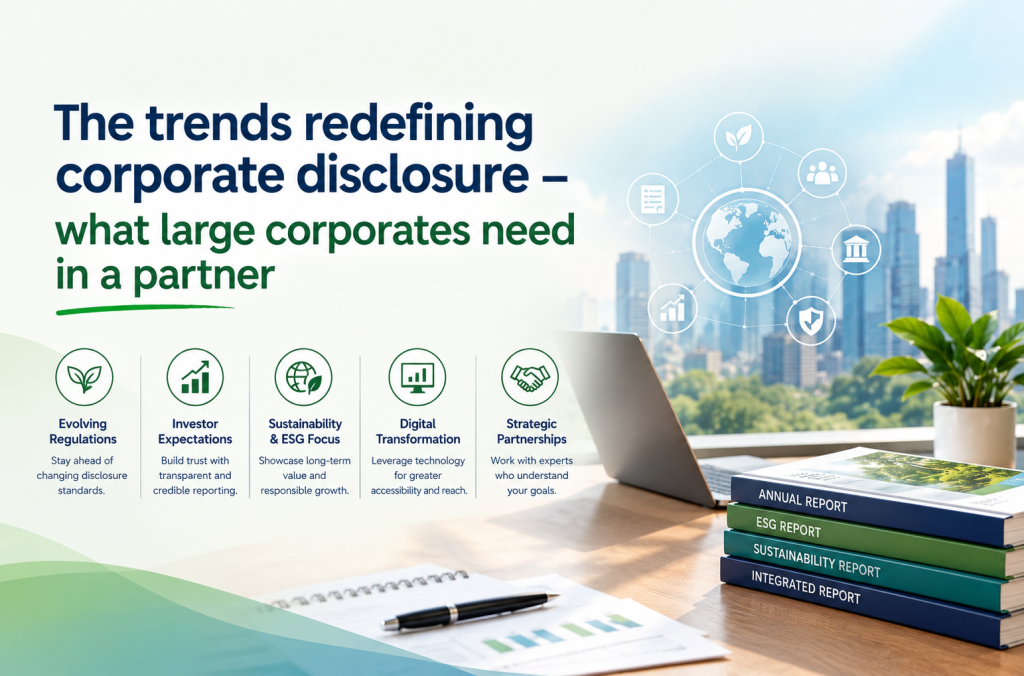
The trends redefining corporate disclosure – what large corporates need in a partner
A Cygnus Perspective on ESG, TCFD Legacy and Sustainability Disclosure
Corporate reporting has quietly gone through one of its biggest structural shifts in a decade. What was once a patchwork of voluntary frameworks, each addressing one part of the ESG puzzle, is moving towards a more connected global architecture. For large corporates, that brings some relief: fewer competing frameworks to navigate. But it also raises the bar on depth, assurance and the ability to connect financial, sustainability and strategic information.
From an alphabet soup of frameworks to a global baseline
Integrated Reporting <IR> was built around a straightforward idea: a company’s value is not created by financial capital alone. When the International Integrated Reporting Council published its <IR> Framework in December 2013, it asked organisations to explain how value is created, preserved or eroded through six capitals: financial, manufactured, intellectual, human, social and relationship, and natural. Its emphasis on the connectivity of information was intended to prevent sustainability information from sitting in a silo away from the financial story.
For years, that ambition existed alongside a crowded field of standards. TCFD addressed climate related financial disclosure. SASB focused on industry specific financial materiality. GRI served stakeholder focused impact reporting. CDSB addressed environmental information. Each addressed an important need, but together they created a reporting landscape that could be difficult for investors and companies to navigate consistently.
That fragmentation has begun to change. The International Sustainability Standards Board, established at COP26 in November 2021, brought together the work of the Climate Disclosure Standards Board and the Value Reporting Foundation, which housed the SASB Standards and the Integrated Reporting Framework. In June 2023, the IFRS Foundation issued the ISSB’s first standards, IFRS S1 and IFRS S2. TCFD subsequently wound down, with its recommendations incorporated into the ISSB standards and the ISSB taking over responsibility for monitoring progress. The practical implication is important. Organisations reporting against IFRS S1 and IFRS S2 are working within a framework designed to carry forward the core architecture of the TCFD recommendations. The reporting question is therefore shifting from ‘Which framework should we use?’ to ‘How well are we executing the requirements and connecting them to the wider business story?’
Adoption is accelerating faster than most reporting calendars can keep up
The pace of jurisdictional movement towards ISSB aligned reporting has been significant. By 2026, standards have been adopted, formally incorporated or proposed across a growing group of major markets, including Japan, Australia, Singapore, Hong Kong, South Korea, Canada, the UK and Brazil. IOSCO has also encouraged its member jurisdictions to consider adoption, reinforcing the direction of travel towards greater global consistency.
This is not limited to listed companies working towards regulatory deadlines. Financial institutions are also incorporating IFRS S1 and S2 into reporting environments that already involve multiple frameworks. For many organisations, the difficult part is no longer collecting historical ESG data. It is explaining anticipated financial effects, transition risks and opportunities, and the way sustainability issues affect strategy and enterprise value. The standards themselves are also evolving. Nature related and human capital disclosures are increasingly becoming part of the wider reporting conversation. For large corporates, that means the baseline cannot be treated as a fixed compliance checklist. Reporting teams need a partner who understands where the requirements are heading, not simply what was required in the previous reporting cycle.
India’s path: BRSR is maturing, but the global gap remains
For Indian large corporates, the immediate reporting environment is shaped by BRSR and the continuing evolution of BRSR Core. SEBI’s revised requirements have increased the focus on assured key performance indicators and created a more structured pathway for the largest listed companies. In parallel, the accountancy profession is developing the assurance ecosystem needed to support this transition.
The challenge is that BRSR and ISSB are not interchangeable. BRSR provides a broad ESG disclosure architecture, while IFRS S2 is specifically designed around climate related financial risks and opportunities. Differences become particularly visible around transition planning, scenario analysis, governance detail and the connection between climate targets and the actions required to deliver them.
Research on reporting practices in India also points to a gradual improvement in the disclosure of renewable energy consumption and Scope 1, Scope 2 and Scope 3 emissions, while standardisation, comparability and granularity continue to require attention.
This is the gap between a compliance filing and an investor grade integrated report. The data may be present, but the connective narrative, the forward-looking transition story and the assurance discipline behind the numbers still determine whether the report feels like a business document or simply a regulatory submission. The real challenge is no longer disclosure volume. It is disclosure quality, connectivity and credibility.
Connectivity, not volume, is what differentiates a report now
One of the enduring ideas behind Integrated Reporting <IR> is that mentioning the six capitals is not enough. A strong report should demonstrate how those capitals interact and how decisions in one area affect value creation elsewhere.
Research into Integrated coring <IR> has repeatedly found significant variation in how clearly companies demonstrate these connections. More recent research has also attempted to measure connectivity across companies and regions, reinforcing the broader shift from asking whether information has been disclosed to asking whether the information actually explains the business.
For large corporates, this distinction matters. Disclosure breadth is increasingly becoming table stakes. What can set a report apart is whether financial performance, ESG metrics, climate risks, opportunities and long term strategy are presented as one coherent story, supported by reliable data and appropriate assurance.
Five shifts worth building into this year’s reporting cycle
- A global baseline is emerging: ISSB provides the core architecture, but legacy and jurisdiction specific requirements such as GRI, ESRS and BRSR still need to work alongside it rather than simply disappear.
- Assurance is becoming structural: BRSR Core and the development of sustainability assurance standards point towards a reporting environment where assurance increasingly sits within the process, not at the end of it.
- Forward looking transition plans matter: The emphasis is moving beyond historical KPIs towards how companies identify, manage and respond to climate related risks and opportunities.
- Nature and human capital are moving up the agenda: Large corporates should expect the disclosure conversation to expand beyond climate and emissions into wider dependencies, impacts, risks and opportunities.
Connectivity is the differentiator: Investors and assurance providers increasingly need to see how strategy, risk, performance, capital allocation and sustainability information relate to one another.
Where this leaves large corporates, and where Cygnus fits
For large corporates navigating a fast-changing sustainability landscape, the right partner needs to bring more than technical expertise. It needs to understand the business, the expectations of investors and stakeholders, and the growing importance of credible, transparent communication.
This is where Cygnus stands apart. We bring together ESG expertise, materiality, stakeholder perspectives and strategic communication to turn complex information into a clear and credible story. Whether it is BRSR, a sustainability report, an integrated annual report, ESG communication or climate related content, our focus is on helping organisations communicate what matters, why it matters and what they are doing about it.
The objective is not simply to meet a requirement. It is to make complex information easier to understand, connect performance with strategy, and give leadership teams, investors and stakeholders a more complete picture of the organisation. That requires more than collecting data. It requires context, judgement and the ability to communicate the bigger picture without losing the detail that gives it credibility.
As expectations around transparency and responsible business continue to rise, Cygnus helps large organisations navigate this change with clarity and confidence. We bring together ESG knowledge and communication expertise to create work that is rigorous enough for scrutiny, clear enough to engage stakeholders, and distinctive enough to represent the organisation behind the numbers. The next phase of corporate reporting will not be defined by how much companies disclose. It will be defined by how clearly; they connect what they disclose to and how the business creates value.
Recent Post
The trends redefining corporate disclosure – what large corporates need in a partner
From Compliance to Competitive Advantage: How Strategic CSR Reporting Drives Business Value
From Spend to Story: Making India's CSR Reports Work Harder
CSR Report: Communicating Impact through Purpose-driven Reporting and Effective Design