


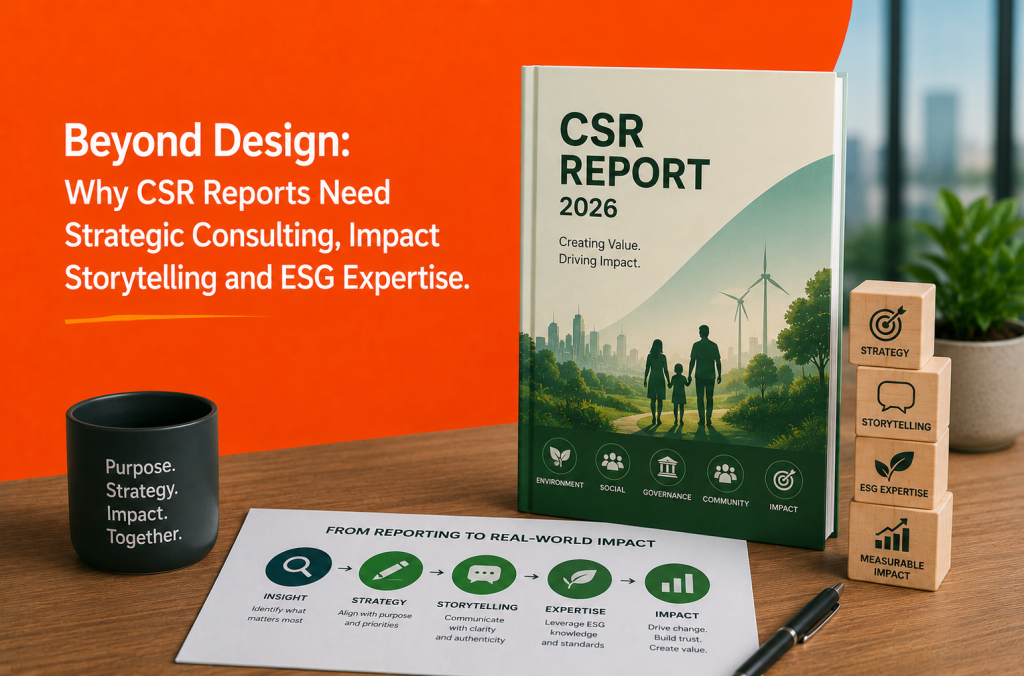
Beyond Design: Why CSR Reports Need Strategic Consulting, Impact Storytelling and ESG Expertise
In today’s corporate environment, sustainability disclosures are integral to credibility and trust. Investors, employees and communities expect transparency and purposeful action, not just polished pages of numbers. In fact, research shows over 60% of people now expect CEOs to address societal issues, not just profits, and companies are tracking more ESG metrics than ever. Regulators are responding too: India’s SEBI now requires the top 1,000 listed companies to file a Business Responsibility and Sustainability Report (BRSR), aligning financial and non‑financial disclosures. In this new landscape, CSR and ESG reports can no longer be afterthought compliance documents – they must become strategic communications that weave together data, narrative and business strategy.
The Rise of Strategic Reporting Partners
The implications are profound for reporting teams. As McKinsey observes, the era of checkbox ESG reports is giving way to a capabilities-based approach. Instead of a “checklist” mentality, companies are being urged to focus on a few societal issues where they can really lead, aligning those efforts with business strategy. This means firms need advisory partners who understand both sustainability and corporate strategy – not just designers who can lay out pages. Indeed, many leading agencies are repositioning themselves this way.
For example, Canadian firm Works Design explicitly calls itself a “trusted advisor” on sustainability reporting. After 14 years of tracking global report trends, their team tells clients to “re-engage, retool and rethink” their approach, integrating strategy at every step. Similarly, US‐based OBATA markets “Integrated Communications” that connect sustainability, investor reporting and branding on one strategic foundation. OBATA’s services span materiality assessment, stakeholder engagement and report design in one package – noting “we don’t just advise. We plan, create, and deliver the finished product, from consulting to final design”. Even global consultancies like FTI Strategic Communications now boast a “holistic point of view” on ESG, offering integrated programs from regulatory strategy through disclosure writing and stakeholder communications. These examples show a clear trend: the future of CSR reporting is end-to-end advisory + creative execution.
Materiality & Stakeholder Engagement
A key part of this strategy is mastering materiality and stakeholder input. In best-practice sustainability reporting, organizations routinely take an ongoing, dynamic view of what really matters. Instead of a one-time checklist, teams form cross-functional ESG committees to gather input from every corner of the business. They map out internal and external stakeholders – employees, customers, investors, community groups, regulators, suppliers, etc. – and actively solicit their priorities. At the same time, companies benchmark peers and global trends (for example mapping issues to the UN SDGs and emerging risks). By scoring each issue on both impact and stakeholder concern, firms can prioritize a focused set of material topics. Crucially, this process is iterative: topics are regularly reviewed so the report stays responsive to new developments.
In practice, this might look like:
- Cross-functional teams of sustainability, operations, finance, HR and comms professionals co-own the assessment.
- Stakeholder interviews and surveys reach across suppliers, local communities, investors and NGOs.
- Benchmarking ties findings to global frameworks like GRI or CSRD and to industry peers.
- Ongoing review treats materiality as a living framework – exactly the “dynamic materiality” approach expert’s advocate.
By embedding materiality in governance, the report’s content stays aligned to the company’s strategy and stakeholder expectations – and compliance with new rules (like double-materiality disclosure) is built into the process.
Impact Storytelling & ESG Communication
Once material topics are clear, the challenge is weaving them into a narrative that engages readers. Here, research and practice stress the power of storytelling with substance. Stakeholders respond to human-centered stories, concrete examples and visualized data – not just bullet-point claims. For instance, rather than simply stating “20% emissions reduction,” leading reports explain how that was achieved: e.g. “By installing solar power at our Mumbai plant (see photo), we cut emissions 20% this year”. Effective narratives also highlight real people – employees who led projects, community members who benefit, customers impacted – to build credibility. This might mean including case studies, testimonials or vivid infographics on the number of beneficiaries (as in the Visual Best redesign above).
Concretely, ESG communication best practices include:
- Transparency: Honestly report both successes and challenges. Admitting “we fell short of Goal X, and here’s why” strengthens trust.
- Human voices: Use quotes or images of people on the ground – project leads, community members, or frontline workers. Such voices make the report relatable.
- Context and outcomes: Tie metrics to impact. For example, saying “10 new water wells served 5,000 villagers” is far more tangible than “$1M spent on water access”.
- Consistency: Frame each year’s report as the next chapter of an ongoing story. Show how last year’s efforts built toward this year’s progress to reinforce a credible journey.
About half of today’s sustainability reports explicitly align their strategy to the UN Sustainable Development Goals. Adding such high-level context helps stakeholders see the big picture beyond the company’s own boundaries. In short, modern CSR reports read like integrated communications campaigns – with clear themes, unified visual branding, and emotional resonance – not just financial filings.
Strategic Frameworks & Disclosures
Behind the storytelling, the technical scaffolding must be solid. Today’s reports often integrate multiple frameworks: GRI Standards, international (CSRD/ESRS) or national (BRSR, TCFD, etc.) guidelines. For example, India’s BRSR now mandates detailed ESG matrices. Cygnus and its peers typically map each section of the report to these frameworks, use standardized data collection templates, and include cross-references (e.g. link material topics to GRI indicators or SDG targets). The result is a publication that not only tells a compelling story, but also meets stringent reporting requirements. As one design analysis notes, the best annual report agencies offer “ESG reporting expertise” as a core skill. In practice, this means they help clients develop sustainability policies, perform impact assessments, and draft disclosures that satisfy auditors and regulators as well as investors.
For listed companies today, this integrated approach is essential. Financial results, sustainability targets, risk factors and governance all belong together. Reports are increasingly “integrated” in the full sense: they bridge traditional annual reporting and CSR reporting. A strategic CSR report consultant or corporate reporting agency will ensure your CSR data is woven into the broader corporate narrative, rather than siloed at the back of the PDF.
Cygnus’s Consulting-Driven Approach
Cygnus Advertising’s corporate reports division embodies this new model. Over the past 8+ years it has produced 250+ CSR, Sustainability, ESG and Integrated reports across industries, and it has built a strong in-house consulting team. As Cygnus itself explains, a well-crafted ESG report “becomes more than data—it becomes a narrative of progress, responsibility, and vision”. The firm stresses that design must serve the story: they blend “strategic insight with visual creativity” to make complex ESG data “engaging, understandable stories”.
Importantly, Cygnus now offers end-to-end CSR reporting consulting, not just layout work. Whether a client is drafting their first sustainability strategy report or refreshing an annual disclosure, Cygnus handles the whole process – from materiality analysis and content development to board messaging and stakeholder engagement. This mirrors the model of global peers, where consultants at Cygnus, align report themes with corporate purpose, guide SDG and ESG strategy, and then translate it all into exemplary visuals.
By positioning itself as a CSR reporting consultant and corporate reporting agency, Cygnus is stepping beyond the traditional designer role. Today, companies don’t just want a prettier report – they want a partner who can help shape sustainability strategy, engage stakeholders, and communicate impact with clarity. Cygnus’s expanded in-house expertise and proven track record make it well-suited to be that partner. In sum, the future of CSR and sustainability reporting is multidisciplinary. It demands strategic planning, rigorous data management, and compelling storytelling in equal measure. As regulators and stakeholders raise the bar, companies need consultants who can wear all those hats. The agents of change – including Cygnus – are the ones blending ESG strategy with brilliant design, ensuring every report does more than inform: it inspires action and builds trust.
Recent Post
The trends redefining corporate disclosure – what large corporates need in a partner
From Compliance to Competitive Advantage: How Strategic CSR Reporting Drives Business Value
From Spend to Story: Making India's CSR Reports Work Harder
CSR Report: Communicating Impact through Purpose-driven Reporting and Effective Design