


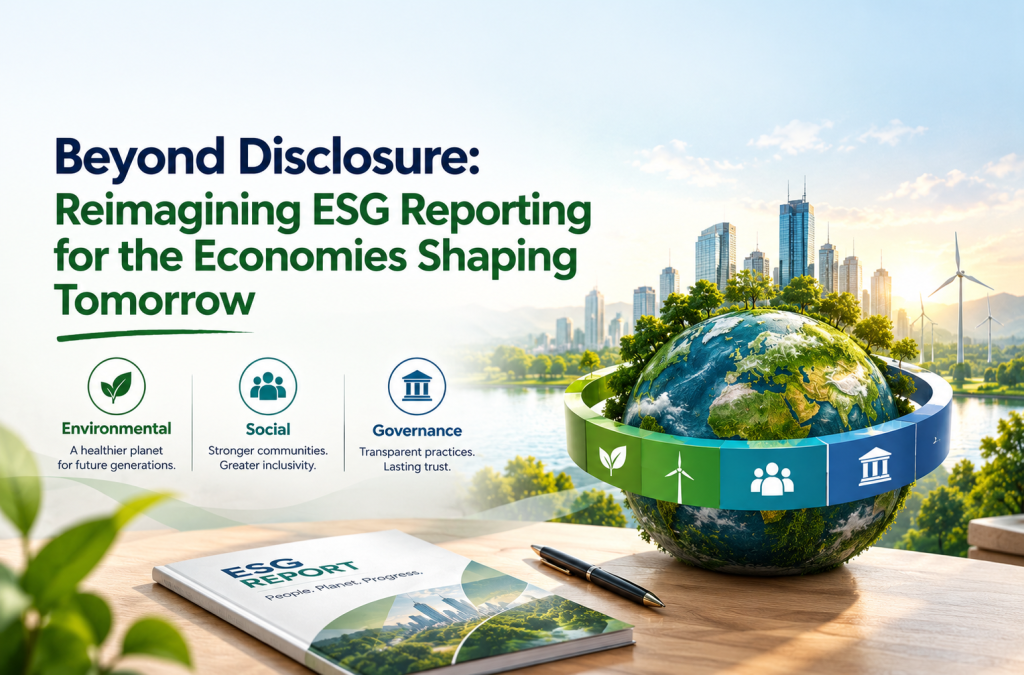
Beyond Disclosure: Reimagining ESG Reporting for the Economies Shaping Tomorrow
As the Gulf accelerates its economic transformation, the next chapter of corporate reporting will demand more than compliance. It will call for clarity, credibility and a compelling account of progress.
Few regions are witnessing an economic transformation as consequential as the Middle East.
Across the Gulf Cooperation Council (GCC), nations are reshaping their economic ambitions, diversifying beyond traditional sources of revenue and investing in industries that will define the next generation of global commerce. From Saudi Arabia’s Vision 2030 to the UAE’s ambition to become a global hub for sustainable finance, from Qatar’s evolving financial ecosystem to Oman’s economic diversification agenda, the region is making a decisive transition towards a more resilient and future-ready model of growth.
But economic progress brings a new set of expectations.
Investors want greater transparency. Regulators are sharpening disclosure requirements. International stakeholders are examining how businesses manage climate exposure, social responsibility, governance and long-term value creation. Sustainability is no longer a peripheral corporate commitment. It is increasingly central to how organisations demonstrate their relevance, resilience and readiness for the future.
And this is where corporate reporting must evolve.
The new language of corporate accountability
The conversation around Environmental, Social and Governance (ESG) performance has moved well beyond publishing a sustainability statement or presenting a collection of environmental initiatives. Businesses are now expected to substantiate their commitments with measurable outcomes, transparent disclosures and a clear connection between sustainability performance and financial strategy.
Global frameworks are providing the architecture for this transition. The Global Reporting Initiative (GRI) continues to shape sustainability disclosures, while the International Sustainability Standards Board’s IFRS S1 and IFRS S2 standards are establishing a common language for sustainability-related financial information and climate disclosures. SASB Standards offer industry-specific guidance, while the International Integrated Reporting Framework encourages organisations to communicate how they create, preserve or erode value over time.
Alongside these, the GHG Protocol, CDP, TNFD and the United Nations Sustainable Development Goals contribute to an increasingly interconnected reporting landscape.
For businesses operating across the GCC and wider Middle East, understanding this landscape is becoming a strategic necessity. Regional exchanges and regulators are progressively strengthening sustainability disclosure expectations, with market-specific guidance emerging across the UAE, Saudi Arabia, Qatar, Oman, Bahrain and Kuwait.
The opportunity, however, extends beyond regulatory preparedness.
Organisations that communicate their sustainability journey with precision can build investor confidence, strengthen institutional credibility and distinguish themselves in an increasingly competitive global marketplace.
From economic ambition to measurable impact
The GCC’s transformation is particularly significant because of the scale and diversity of its ambitions.
Saudi Arabia is pursuing a sweeping economic restructuring through Vision 2030. The UAE continues to strengthen its position across financial services, real estate, logistics, renewable energy and advanced manufacturing. Qatar is investing in economic diversification while developing its financial and institutional landscape. Oman is advancing industrial development, logistics and tourism, while Bahrain and Kuwait are strengthening their respective financial and commercial ecosystems.
These are not isolated developments. They represent a broader shift in the region’s relationship with global capital, international trade and sustainable development.
For businesses participating in this transformation, the quality of corporate disclosure will increasingly influence how their progress is understood.
An annual report must do more than recount financial performance. A sustainability report must go beyond declarations of intent. An integrated report must demonstrate how strategy, governance, performance and prospects connect to the organisation’s ability to create value.
The challenge is to bring these narratives together without compromising technical accuracy or editorial integrity.
The Cygnus proposition: Where technical rigour meets creative intelligence
At Cygnus Advertising, we see this changing landscape as an opportunity to redefine the value that corporate reporting partners bring to growing economies.
Our approach rests on a simple belief: a report should not merely contain information. It should make that information meaningful.
We bring together corporate reporting expertise, ESG-oriented content development, strategic communication, design thinking and digital publishing to help organisations present their performance with greater clarity and conviction.
Our capabilities span the corporate reporting spectrum:
ESG and sustainability reporting: Developing structured, stakeholder-oriented narratives aligned with relevant reporting frameworks and disclosure requirements, including GRI, ISSB, SASB and other applicable standards.
Integrated and annual reporting: Connecting financial and non-financial performance, governance, strategy and long-term value creation through coherent, investor-focused communication.
ESG content and disclosure development: Translating complex sustainability information into well-structured narratives, supported by material topics, performance indicators and transparent disclosures.
Report design and digital publishing: Transforming information-heavy documents into accessible, visually compelling publications through thoughtful design, data visualisation, interactive PDFs and digital reporting platforms.
Reporting production and delivery: Providing end-to-end content, design, typesetting and production support, including delivery partnerships for specialist consultancies and corporate communication agencies.
Our proposition is not built around design alone, nor does it treat sustainability reporting as a purely technical exercise. It brings these disciplines together to create a reporting experience that is credible, coherent and commercially relevant.
Where specialist expertise is required for emissions calculations, engineering assessments, climate modelling or independent assurance, we recognise the importance of qualified technical partners. Sound reporting begins with sound evidence, and credibility must never be compromised for presentation.
A new-age value provider for a changing global economy
Emerging and rapidly developing economies need partners who understand both the complexity of international reporting expectations and the practical realities of business growth.
This is particularly relevant across the Middle East, where organisations are navigating diverse regulatory environments, expanding investor expectations and increasingly global stakeholder relationships.
Cygnus aims to serve this evolving market through a delivery model that combines international reporting perspectives with the agility, collaborative approach and production capabilities of an experienced corporate communications organisation based in India.
For businesses, this means access to a partner capable of supporting the journey from information architecture and content development to design, production and digital dissemination.
For sustainability consultancies and advisory firms, it creates an opportunity to collaborate through specialist delivery support, white-label report development and scalable production capabilities.
For listed companies, financial institutions, energy businesses, infrastructure groups and real estate organisations, it offers a way to strengthen the communication of corporate performance without losing sight of the underlying substance.
We believe that the future of reporting will belong to organisations that can bridge technical understanding with effective communication. That is the space Cygnus intends to occupy.
Beyond the report lies the real opportunity
The next decade will be consequential for the Middle East. Investments in clean energy, infrastructure, financial services, smart cities, manufacturing and diversified industries will reshape the region’s economic standing. As these ambitions take shape, the ability to demonstrate responsible growth will become as important as the growth itself.
ESG reporting will have a significant role in that story. Integrated reporting will help articulate the relationship between strategy, resources, performance and long-term value. Digital communication will make corporate information more accessible to an increasingly diverse stakeholder base.
Yet the real measure of a good report will not be the number of pages published or the number of frameworks referenced. It will be whether the information is reliable, the narrative is intelligible and the organisation’s progress can be understood and evaluated.
At Cygnus, we are looking beyond geographical boundaries to build meaningful partnerships with businesses and institutions shaping this new economic chapter.
Because the future of corporate reporting is not simply about reporting what an organisation has done. It is about demonstrating what it stands for, how it creates value and where it intends to go.
- Meta description: Discover how Cygnus is advancing ESG, sustainability and integrated reporting for businesses across the GCC and Middle East through strategic content, design and digital reporting.
- Suggested URL slug: esg-integrated-reporting-middle-east-gcc
Recent Post
Beyond Disclosure: Reimagining ESG Reporting for the Economies Shaping Tomorrow
The trends redefining corporate disclosure – what large corporates need in a partner
From Compliance to Competitive Advantage: How Strategic CSR Reporting Drives Business Value
From Spend to Story: Making India's CSR Reports Work Harder